
How Industrial Water Cooling Systems Scale Across Plants
Scaling industrial water cooling systems is rarely a matter of multiplying the capacity of one existing unit. A system that holds process temperature at one plant can behave differently at a second site because production schedules, ambient conditions, water quality, piping runs, and maintenance access change. From an equipment-integration perspective, the useful question is not “How large should the next chiller be?” but “What operating envelope must this plant reproduce, measure, and maintain?”
An industrial water chiller is one part of that envelope. Pumps, headers, heat-rejection equipment, controls, fluid-management practices, and the process load all determine whether industrial water cooling systems remain stable as a network grows. The practical goal is repeatable cooling performance with clear room for different plant conditions.
Start with a plant-by-plant cooling baseline
Before duplicating a design, document what the existing plant actually sees. Nameplate capacity and a target supply-water temperature are not enough. Map the loads by process area, shift, product mix, startup condition, and season. Record supply and return temperatures, flow, differential pressure, runtime, alarms, and any manual interventions. If heat load changes substantially, target temperature alone is not enough to judge the next installation.
This baseline turns industrial water cooling systems into an engineering standard rather than a collection of equipment. It also separates confirmed conditions from assumptions. For example, a pilot line may have short high-load peaks, while a mature plant may have a flatter twenty-four-hour demand. Both may use the same process, yet their preferred staging and buffer strategy can differ.
- Define the required temperature band at each critical load.
- Capture peak, average, and ramping thermal demand instead of one design estimate.
- Confirm the fluid, filtration, chemistry, and allowable pressure drop.
- List production consequences of a temperature excursion and the available response time.
Choose an architecture that can be repeated and isolated
When facilities expand, a single central plant is not automatically the right answer. A central arrangement may simplify oversight where buildings are close and process conditions are alike. Distributed industrial water cooling systems can be easier to phase, isolate, and adapt when sites have different utilities, layouts, or operating hours. The decision should compare pipe losses, redundancy needs, commissioning sequence, service access, and the cost of interrupting production—not just installed capacity.
A repeatable design usually defines functional modules: process loops, a cooling-production module, heat-rejection equipment, make-up and treatment points, electrical isolation, and a control connection. Standardizing these functions does not mean forcing identical hardware into every plant. It means preserving the same decision logic while allowing local changes in heat load, elevation, ambient climate, and code requirements.
Hydraulic separation deserves early attention. Long headers, added branches, or different pump curves can upset flow at existing users when a new line starts. Decoupled loops, properly located sensors, and validated minimum-flow paths may help, but the arrangement must match the actual process and equipment requirements. Treat each expansion as a system-boundary review, not a simple pipe extension.
Scale capacity in stages, not as a single prediction
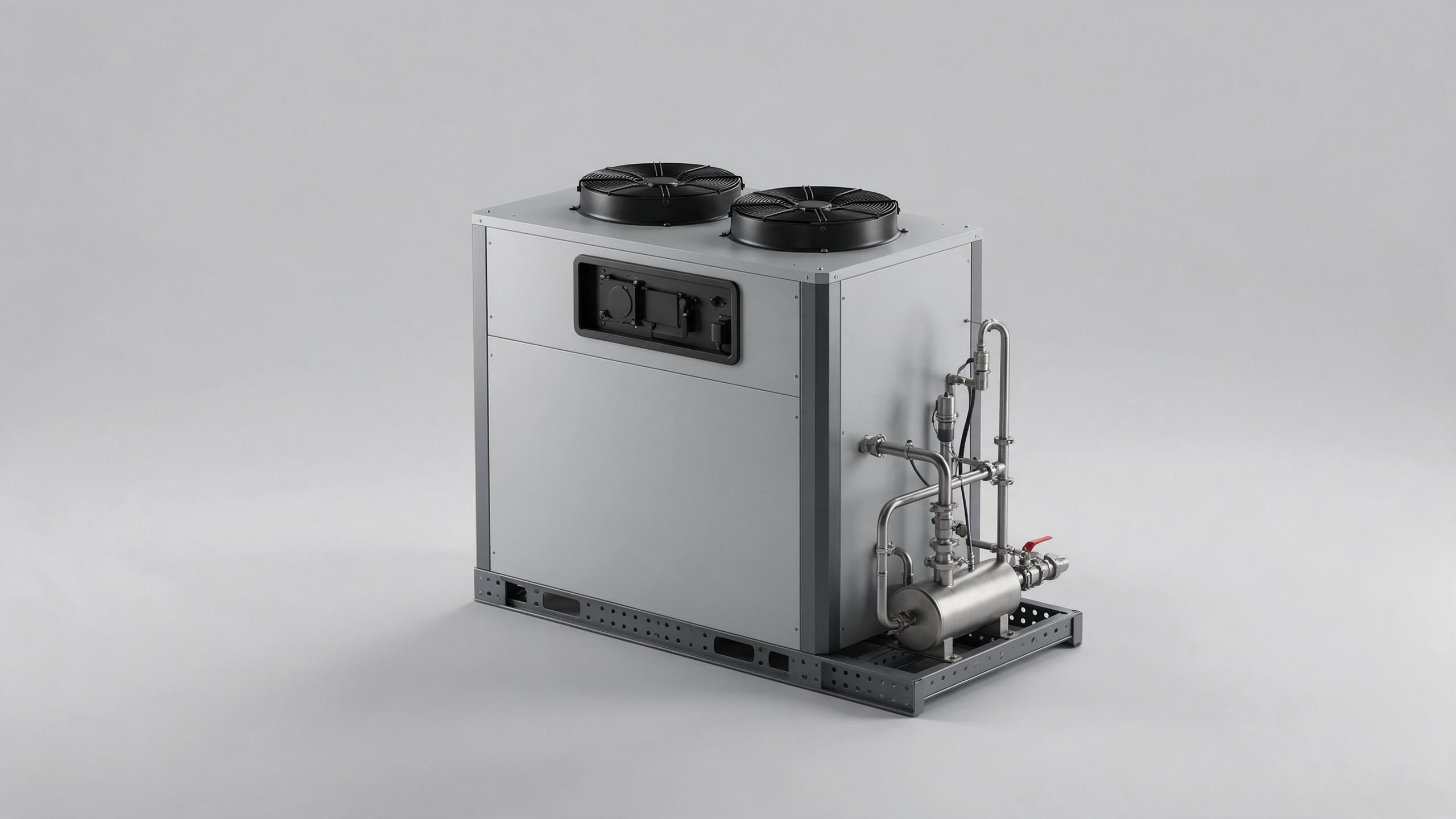
Plants often grow in uneven increments. That makes staged capacity useful for many industrial water cooling systems. Multiple cooling modules can support maintenance and allow capacity to follow confirmed demand, provided the plant has a documented sequence for enabling, unloading, and isolating each module. An oversized unit that spends most of its time far from the intended operating range may create control and maintenance questions that were hidden in the original estimate.
The same principle applies to an industrial water chiller serving a critical process loop. Define the conditions for adding the next stage: sustained return-water temperature, loading trend, flow, available heat rejection, and a time delay that avoids rapid cycling. The exact values must come from the selected equipment, process tolerance, and site tests. A generic staging number should not be copied between plants.
| Scaling decision | What to verify | Why it matters |
|---|---|---|
| Add a cooling module | Load duration, available flow, heat rejection, electrical capacity | Avoids reacting to a short process peak as if it were permanent demand. |
| Extend a process loop | Pressure drop, branch balancing, minimum flow, fluid condition | New piping can change conditions at existing machines. |
| Replicate at another plant | Climate, water source, layout, shift pattern, local maintenance support | Nominally similar production can have different operating envelopes. |
Make controls and data portable
A scalable cooling strategy needs more than a shared HMI screen. Standardize the data model for industrial water cooling systems: tag names, engineering units, alarm priorities, trend intervals, and definitions of normal operation. Then give each plant the ability to retain its local limits and permissives. This combination lets engineering compare plants without erasing meaningful local differences.
Useful trends include supply and return temperature, flow, differential pressure, equipment status, valve position, pump speed, treatment indicators, and alarm history. At commissioning, verify sensor placement and calibration before using a trend as a cross-plant performance comparison. A consistent dashboard built on inconsistent field data only spreads uncertainty faster.
Sequencing should be tested through realistic transitions: line startup, partial shutdown, a module fault, and recovery after a utility interruption. Guidance for water-cooled plant operation commonly identifies flow setpoints and ordered pump/chiller staging as control requirements. In a process application, those requirements must be reconciled with the process equipment’s own flow and temperature limits.
Design maintenance into the scale-up plan
Maintenance capacity is a scaling variable. More industrial water cooling systems mean more strainers, treatment checks, sensors, valves, and heat-transfer surfaces that need defined ownership. Fouling or poor water management can raise cooling demand and affect heat rejection, so a plant network should include accessible inspection points, isolation valves, drain paths, spare-parts policy, and a documented water-treatment routine.
Standard work helps teams learn across sites. Use the same inspection checklist, alarm response format, and post-event review template, while allowing a plant to add local tasks. Track recurring causes such as low flow, drifting temperature, blocked heat-rejection surfaces, or abnormal cycling. That record is more useful than an anecdotal claim that one configuration works everywhere.
Use a commissioning gate before calling a plant scalable
Each new installation should prove its own duty before it becomes part of the fleet standard. For industrial water cooling systems, a commissioning gate can include sensor validation, hydraulic balancing, safety and interlock checks, control-sequence tests, load-response observations, water-quality review, operator training, and a handover of trend baselines. Document what passed, what remains to be observed over seasonal operation, and what evidence supports the next phase.
The result is a controlled learning loop. One plant supplies a repeatable template; the next plant tests it under its own conditions; both feed a clearer design standard. By scaling measured operating envelopes, staged capacity, interfaces, controls, and maintenance routines together, industrial water cooling systems can grow across plants without relying on a single oversized assumption.
 Hot News