
How to Screen an Industrial Water Chiller Supplier
An industrial water chiller supplier should be screened as an engineering partner, not simply as a catalog source. A model that looks suitable on a quotation may still be a poor fit if its stated capacity assumes different water temperatures, fluid properties, electrical supply, or load behavior than your process. For an industrial water chiller purchase, the practical question is: can the supplier explain the basis of its selection and document what will be supplied?
From an industrial procurement perspective, the most useful comparison starts before price negotiation. Ask each industrial water chiller supplier to respond to the same technical brief, then compare the completeness and consistency of the response. That approach gives engineering, purchasing, and operations a shared basis for review.
Start with a clear process brief
Do not ask an industrial water chiller supplier to “recommend a unit” with only a target temperature. Correct sizing depends on the process heat load, circulation flow, temperature difference, fluid type, and operating conditions. If those inputs are uncertain, say so. A capable vendor can identify what is missing, state its assumptions, and explain how those assumptions affect selection.
Prepare a short request-for-information package with the following items:
- Required supply temperature, permitted control band, and return temperature;
- Estimated heat load, including steady, peak, and transient conditions where known;
- Fluid or water treatment details, required flow rate, and allowable pressure drop;
- Ambient or condenser-water conditions for the intended installation;
- Electrical supply, footprint, noise, piping, drainage, and control-connection constraints;
- Expected duty cycle, maintenance access, and the consequences of an unplanned stop.
This list is not a sizing calculation. It gives every bidder the same project facts to address. Where information is incomplete, ask the supplier to label the open item rather than fill the gap with an unstated assumption.
Check capacity at your conditions, not a catalog headline
A cooling-capacity figure only becomes useful when the rating conditions are visible. Ask the vendor to identify the entering and leaving fluid temperatures, flow, ambient or condenser conditions, and electrical configuration associated with the proposed duty point. For a water-cooled system, the condenser-water conditions and flow matter too. For an industrial water chiller, the quoted value may change when the real temperature lift or fluid differs from the published rating basis.
Request part-load information when the process rarely runs at one steady load. You are not looking for a universal performance claim; you need a traceable statement of how the proposed unit is expected to operate across the conditions that matter to your line. If a supplier cannot distinguish rated conditions from project conditions, treat that as a gap to resolve before comparing price.
Review the supplier’s technical documents
A serious chiller vendor should be able to organize a submittal package around the quoted configuration. Depending on the project, useful documents may include a performance sheet at stated conditions, general arrangement drawings, water-side data, electrical data, installation requirements, controls documentation, and maintenance information. Availability varies by product and project, so request the documents you need rather than assuming they are standard.
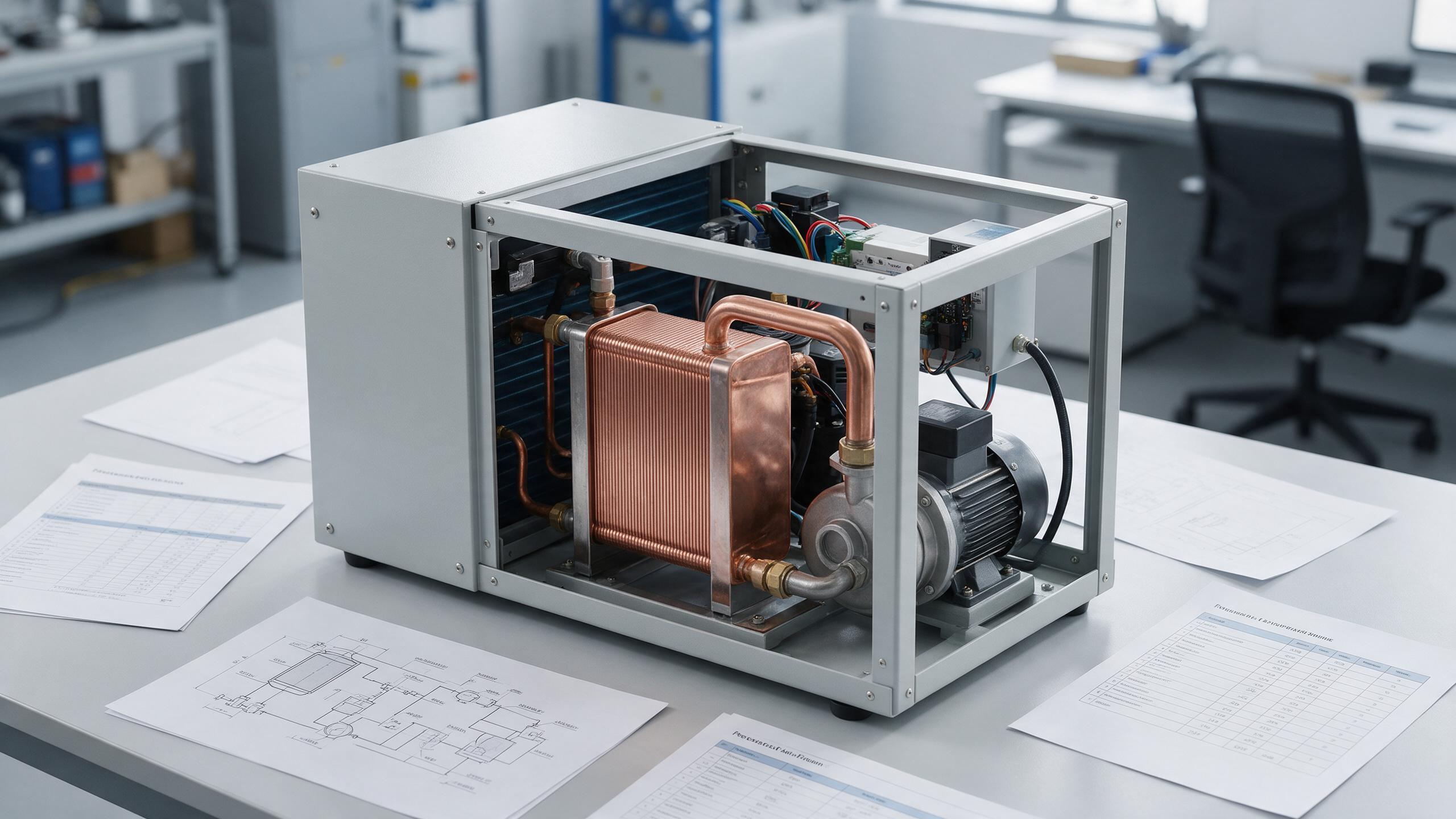
Use a simple document matrix for each bidder:
| Review area | What to request | Why it matters |
|---|---|---|
| Thermal duty | Capacity statement with rating conditions and assumptions | Lets the team compare like for like. |
| Hydraulics | Flow range, pressure-drop information, pump scope, and connections | Shows whether the proposed equipment can fit the circuit. |
| Electrical and controls | Power data, wiring requirements, alarms, and control-connection details | Reduces integration ambiguity. |
| Installation and service | Dimensions, access clearances, consumables, and maintenance schedule | Supports site planning and lifecycle review. |
| Verification | Factory-test scope, acceptance criteria, and records available | Defines what can be checked before handover. |
The quality of this package often reveals more than a polished brochure. An industrial water chiller supplier that names exclusions, asks follow-up questions, and revises a selection when conditions change is making its engineering boundary visible.
Assess integration and operating support
A process chiller does not operate alone. Review piping connections, filtration or fluid-management responsibilities, sensor locations, drainage, ventilation, control signals, and fault handling with the proposed supplier. Ask the vendor which items it owns, which are site-supplied, and which need joint confirmation. This matters especially when a process skid, building utility, or automation system must exchange signals with the cooling unit.
Support should also be evaluated as a response process. Ask how commissioning questions are handled, what information the supplier needs for remote diagnosis, what routine maintenance tasks are expected, and how spare-parts identification works. Avoid treating a promise of “support” as evidence; ask for the communication path, the documentation supplied at handover, and the constraints that could affect response.
Compare proposals with a weighted scorecard
Once responses arrive, use the same scorecard for every bidder. Weight project-fit evidence more heavily than presentation quality. A practical scorecard can cover thermal fit, hydraulic fit, controls and electrical fit, documentation completeness, verification plan, service practicality, commercial terms, and clarity of exclusions.
Keep a separate column for assumptions that still need confirmation. This prevents the team from giving a high score to a vendor whose proposal is detailed only because it quietly assumed favorable conditions. A lower initial quote may need further review if it omits accessories, site work, testing, or connection items included elsewhere.
Use a clarification meeting before award
Before selecting a supplier, hold a short technical clarification meeting with the finalist. Walk through the duty point, drawings, control-connection details, commissioning sequence, and acceptance-test approach. Ask the supplier to confirm what would cause a reselection or design change. The purpose is not to force certainty where process inputs remain unknown; it is to make uncertainty visible and assign the next verification step.
For complex thermal-control projects, a supplier should be evaluated on the quality of this dialogue as well as on equipment data. A supplier that keeps the discussion tied to temperature range, heat load, fluid, connection details, and test conditions gives your team a clearer basis for an industrial water chiller decision.
Final screening checklist
- Does the supplier show capacity at your stated conditions?
- Are load, flow, fluid, and temperature assumptions recorded?
- Are water-side, electrical, controls, and installation documents sufficient for your review?
- Are responsibilities, exclusions, and site connection responsibilities clear?
- Is there a credible commissioning and acceptance-test path?
- Can operations understand the maintenance and support process for the proposed cooling unit?
Supplier screening is therefore a comparison of evidence, not a search for a single headline specification. A disciplined brief, common document list, and clarification meeting help the team select a cooling configuration with fewer hidden assumptions and a more workable path to verification.
 Hot News