
What a Pipe Heating System Must Achieve for CVD Gas Lines
A CVD gas line is not ordinary utility piping. It is part of the process-delivery path, so a pipe heating system has to do more than make a tube warm. It must help keep temperature-sensitive vapor or precursor material in the intended phase from source to point of use, while remaining controllable, serviceable, and safe within the tool. The right question is therefore not “what wattage should we install?” but “what thermal behavior must the line achieve under real process conditions?”
From an equipment-integration perspective, the answer begins with the actual precursor, line geometry, flow regime, ambient losses, fittings, valves, and the tool’s operating sequence. A pipe heating system can only be judged against those conditions. A generic setpoint, blanket style, or insulation thickness is not proof that a CVD line will deliver stable vapor.
1. Maintain a verified temperature margin along the whole delivery path
The primary job of a pipe heating system is to avoid cold locations that can promote condensation, adsorption, or a shift in vapor composition. This does not mean selecting the highest possible temperature. The process owner should define an acceptable operating window using the material’s handling guidance and the actual pressure conditions, then validate that window at the locations that matter.
That path includes more than the straight run. Elbows, tees, valve bodies, filters, regulators, flexible sections, instrument connections, and the transition into the process chamber often have different heat losses and thermal masses. A well-designed pipe heating system needs to address these discontinuities rather than reporting one sensor reading from the easiest section of pipe.
For a new tool, ask for a temperature map or commissioning plan that identifies the coldest credible point. If the line is segmented, define whether each segment is meant to track one setpoint or hold a deliberate temperature relationship to the source and downstream hardware. Multi-zone control can be useful where heat loss or process needs vary, but its benefit depends on sensor placement and a clear control objective.
2. Deliver uniform heating, not just adequate average heat
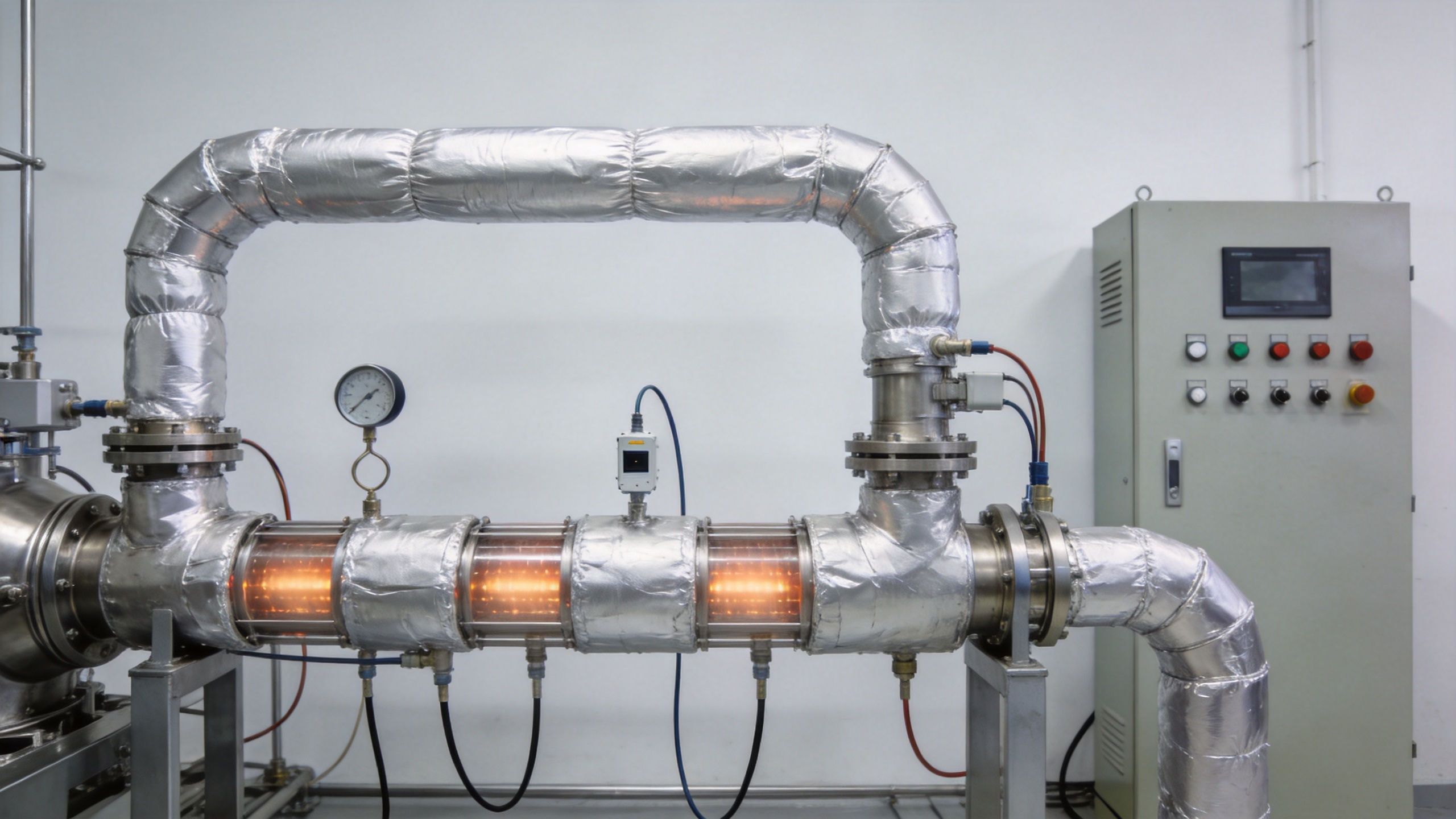
Average temperature can conceal local problems. A pipe heating system should provide sufficiently even circumferential and axial heat transfer for the piping, components, and insulation arrangement being installed. Gaps in coverage, loose contact, poorly fitted insulation, or a heater that bridges an irregular fitting can create a low-temperature pocket even when the controller display looks normal.
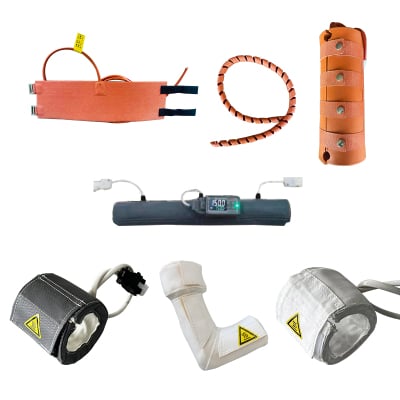
A pipe heater jacket can be a practical format when access, retrofitting, or maintenance calls for a removable solution. But removability should not be confused with suitability. The jacket needs the correct dimensions, closure arrangement, thermal contact, bend tolerance, and termination protection for the actual assembly. For a critical section, a custom pipe heater jacket may be easier to fit consistently than a generic wrap, provided its design is reviewed with the component geometry and cleaning requirements in mind.
Uniformity also depends on how the system responds during warm-up, idle periods, recipe changes, and recovery after a door-open or service event. A pipe heating jacket that performs acceptably at steady state may still create a transient cold spot if its control strategy and sensor location do not represent the slowest part of the assembly.
3. Control temperature at the right place and prove it stays controlled
A controller is not the same as process control. For a pipe heating system, the sensor should be selected and located so that its reading has a defensible relationship to the condition the process needs. A sensor on an exposed outer surface may react differently from the pipe wall beneath insulation; a single sensor may not reveal behavior at a heavy valve block or a long unheated lead.
Specify the control loop, sensor type, number of zones, alarm logic, and allowable deviation in terms of the qualified process window. Where multiple zones are used, define how they interact during start-up and shut-down. PID control is commonly used for precise thermal applications, but tuning, sensor attachment, and thermal lag still require commissioning checks. The acceptance record should show actual response, not simply a controller model number.
For a flexible pipe heating jacket, confirm that installation and reinstallation do not move sensors or change contact pressure enough to invalidate the original tuning. If a section must be opened routinely, repeatable placement markers and an inspection step can be more valuable than a nominally sophisticated controller.
4. Limit heat loss without creating hidden maintenance risks
Insulation and enclosure design let a pipe heating system use energy more effectively and reduce sensitivity to room-air changes. Yet insulation must also work with access, leak inspection, cable routing, bend radius, and the facility’s maintenance practice. A jacket that is difficult to remove may be left in place when technicians need to examine a fitting; one that is too easy to disturb may return with gaps after service.
The industrial heating jacket should therefore be evaluated as an assembly: heater, insulation, fasteners, sensor leads, power leads, labels, and the underlying line. Confirm that nearby materials, electrical interfaces, and personnel-access areas are considered in the tool’s hazard assessment. Semiconductor equipment projects may use SEMI safety guidance as part of the broader project framework, but an article or component description alone cannot establish compliance.
5. Fail safely and make abnormal conditions visible
A process line needs predictable behavior when a sensor opens, a heater circuit fails, insulation is damaged, a zone overshoots, or power returns after an interruption. The pipe heating system should provide appropriately engineered protective functions, such as independent over-temperature protection where the risk assessment calls for it, fault indication, and a defined response that the equipment team can test.
Alarm usefulness matters as much as alarm presence. The control design should distinguish a minor tracking deviation from a condition that can threaten material delivery or equipment safety. It should also make the affected zone identifiable. If a pipe heater jacket is removable, inspect its connectors, strain relief, and closure condition before returning the tool to production.
6. Support cleaning, replacement, and documented requalification
CVD tools rarely stay untouched after installation. Lines and components may be serviced, replaced, reconfigured, or exposed to maintenance activities. A pipe heating system must allow those actions without turning every intervention into an uncontrolled thermal change. Record the installation orientation, sensor locations, insulation sequence, zone identifiers, controller settings, and acceptance-test method.
This is where a pipe heating jacket or industrial heating jacket should be assessed for lifecycle fit, not only initial installation. Can technicians remove it without damaging a cable? Can they refit it in the same orientation? Is there an inspection criterion for degraded insulation or closure wear? These questions prevent a previously qualified line from drifting into an unverified state.
A practical acceptance checklist
- Define the qualified temperature window for the material, pressure, and process sequence; do not rely on a generic setpoint.
- Map every credible cold spot, including fittings, valves, transitions, and flexible sections.
- Verify heat coverage, insulation continuity, sensor placement, and zone boundaries on the installed assembly.
- Test warm-up, steady state, idle, restart, and credible fault behavior against documented acceptance criteria.
- Document service and requalification steps so replacement or removal of a pipe heating jacket does not silently change thermal performance.
Conclusion
For CVD gas delivery, a pipe heating system succeeds when it supports stable, verified thermal conditions over the complete path—not when it merely reaches a displayed temperature. Start with the process window, then assess coverage, uniformity, sensing, zoning, insulation, fault response, and maintainability together. That approach makes it easier to specify an industrial heating jacket or other heating method without overstating what any single component can guarantee.
 Hot News