
What an Industrial Chiller Machine Delivers for Continuous Processes
In a continuous process, temperature control is not a comfort function. It is part of the operating condition that lets equipment, material, and controls behave predictably from one shift to the next. An industrial chiller machine removes heat from a recirculating fluid loop and sends that fluid back to the process at a controlled condition. The useful outcome is not simply cold water. It is a more repeatable thermal environment when the unit, piping, fluid, controls, and process load are considered as one system.
From a thermal-management application perspective, the first question is usually not “Which industrial chiller has the largest rating?” It is “What must remain stable at the point of use, and under what changing load?” That distinction matters in semiconductor equipment, chemical processing, battery testing, laser systems, and other operations where a temperature excursion may affect yield, cycle time, equipment availability, or the next production step.
It Delivers a Controlled Heat-Removal Path
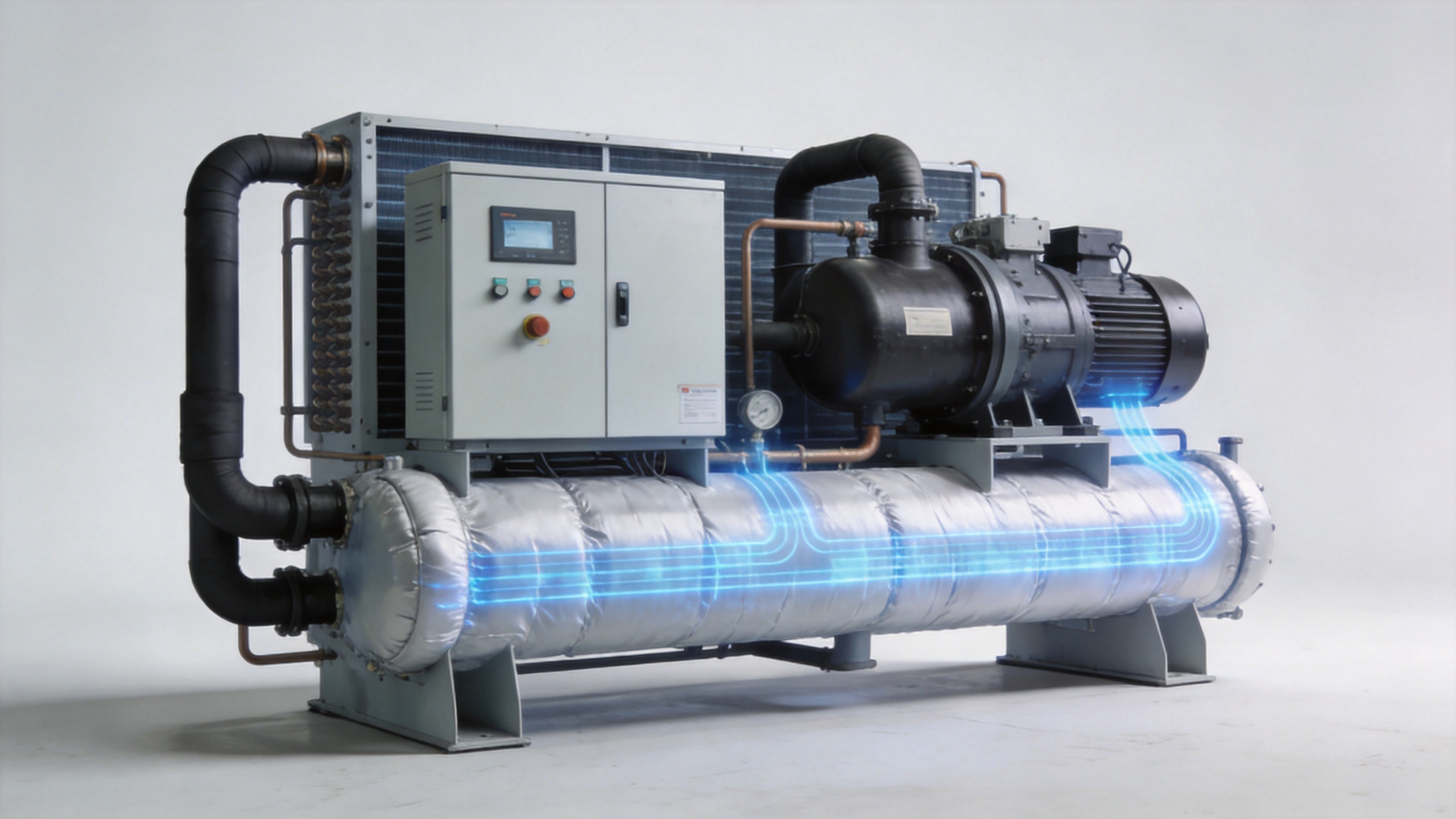
An industrial chiller machine gives process heat a defined route out of the loop. The circulating fluid absorbs heat at the tool, reactor jacket, fixture, or other load. The chiller then rejects that heat through its refrigeration and heat-rejection system before recirculating the fluid. In a continuous application, that loop can help the process avoid accumulating heat over time.
The important word is controlled. A process may run at a steady average load but still experience starts, stops, valve changes, material changes, or shifts in ambient conditions. A properly matched industrial chiller machine is selected around the expected operating envelope, including peak heat load rather than an average number alone. This gives the control system enough room to respond when the process is not behaving like a static test.
It Supports Repeatability, Not Just a Setpoint
A display setpoint is a useful reference, but it is not the same as the temperature seen by the process. Fluid can gain or lose heat in piping, hoses, fittings, and manifolds. Flow changes can alter heat transfer. A sensor in a reservoir may react differently from a sensor closer to the supply leaving the refrigeration circuit. For an industrial chiller machine, the commissioning target should therefore be the delivered condition at the process connection, measured under representative load.
This is why temperature stability should be specified with context: the required band, fluid, flow, load profile, measurement location, and response time. A tighter number is not automatically the right requirement. It can add control and component complexity without improving a process that has a wider acceptable range. Conversely, a sensitive process may need closer control and a clearer validation plan. The right industrial chiller decision comes from matching the thermal tolerance to the actual process, not from comparing nameplate figures in isolation.
It Helps a Continuous Line Absorb Load Changes
Continuous work does not mean unchanging work. Pumps, heaters, motors, tooling, chemical reactions, or electronics can alter the heat entering the loop. An industrial chiller machine contributes by monitoring temperature and adjusting cooling capacity so the supply condition moves back toward the intended operating range. How quickly and smoothly that happens depends on the load profile, fluid volume, control logic, sensor placement, valve behavior, and hydraulic design.
In practice, an application team should map at least three conditions: normal running load, the highest expected load, and transitions such as startup or recipe changeover. It is also sensible to ask whether several loads share one loop. One load may be stable while another is cycling, and their interaction can make the common return temperature harder to interpret. Treating the industrial chiller machine as part of the system, rather than as a standalone box, exposes these interactions early.
It Creates Useful Operating Visibility
A well-integrated industrial chiller machine can provide operational signals that help teams see drift before it becomes a larger interruption. Depending on the configuration, useful values may include supply and return temperature, flow condition, pressure, alarms, and controller status. These signals do not diagnose every issue by themselves, but they give maintenance and process teams a starting point for asking better questions.
- Is return temperature gradually rising at the same production rate?
- Has flow changed after a filter, hose, or valve intervention?
- Does the deviation appear only during a particular product or recipe?
- Is ambient heat, condenser condition, or water quality affecting heat rejection?
- Do alarms align with a pump event, a process event, or a control change?
Trend data is particularly valuable for continuous operations because a slow change can be more informative than a single snapshot. The aim is not to assume that every temperature change originates in the chiller. The loop, process load, controls, and installation conditions all deserve review.
It Supports a More Practical Reliability Plan
An industrial chiller machine contributes to dependable continuous processing when its maintenance needs are visible and scheduled around the operating environment. The exact routine depends on the unit and the application, but a plan commonly addresses fluid condition, filters or strainers, heat-rejection surfaces, hoses and fittings, pump behavior, sensors, alarms, and documented operating trends. A change in any one of these areas can affect delivered performance.
Maintenance is also where the system view becomes useful. For example, cleaning a heat-rejection surface may be appropriate, but the team should still verify whether the observed issue was caused by ambient conditions, load growth, restricted flow, or a changed setpoint. Recording the operating condition alongside the intervention makes later troubleshooting more defensible. For a continuous process, that record can be more useful than a generic maintenance checklist alone.
What to Confirm Before Selecting an Industrial Chiller Machine
Before comparing configurations, assemble the inputs that describe the process rather than only the desired supply temperature. This checklist helps turn a broad cooling request into an engineering discussion:
- Temperature target and tolerance: State the required temperature at the process connection and the acceptable variation.
- Heat load profile: Identify normal, peak, startup, and transient loads; distinguish measured values from estimates.
- Fluid and hydraulic conditions: Confirm the compatible fluid, required flow, pressure drop, loop volume, and piping arrangement.
- Heat rejection environment: Review installation space, ambient conditions, water availability where relevant, and service access.
- Controls and interfaces: Define alarms, remote signals, communication needs, interlocks, and how the process should respond to an abnormal condition.
- Validation method: Agree on where temperature will be measured and which operating points must be demonstrated before full production.
The Practical Deliverable Is Thermal Control You Can Verify
The value of an industrial chiller machine in a continuous process is a managed thermal condition that can be checked against real operating needs. It removes heat, supports stable delivery, provides information for operations, and gives teams a framework for evaluating change. Those outcomes depend on the fit between the industrial chiller machine and the full application: heat load, fluid loop, controls, installation, and maintenance practice.
For a new project or an upgrade, start with the process data and define the acceptance condition at the point of use. That approach makes an industrial chiller selection more meaningful, because the resulting conversation is about verified process requirements rather than a generic capacity comparison.
 Hot News