
Why an Industrial Pipe Heating Jacket Outlasts Wrapped Heaters
A jacket does not automatically last longer just because it is called industrial. Its service life depends on how well it fits the pipe, protects the heating circuit, survives access work, and is returned to its original position after maintenance. For an industrial pipe heating jacket, those details often matter more than a headline wattage figure or an initial purchase price.
From an industrial procurement perspective, the useful comparison is not “jacket versus wrap” in the abstract. It is whether the chosen assembly can hold its intended thermal condition while operators inspect valves, remove insulation, clean equipment, and reconnect the system without repeatedly stressing cables, seams, or fasteners. An industrial pipe heating jacket is therefore a system decision involving the pipe, the heater, insulation, controls, access frequency, and the surrounding process.
What is being compared?
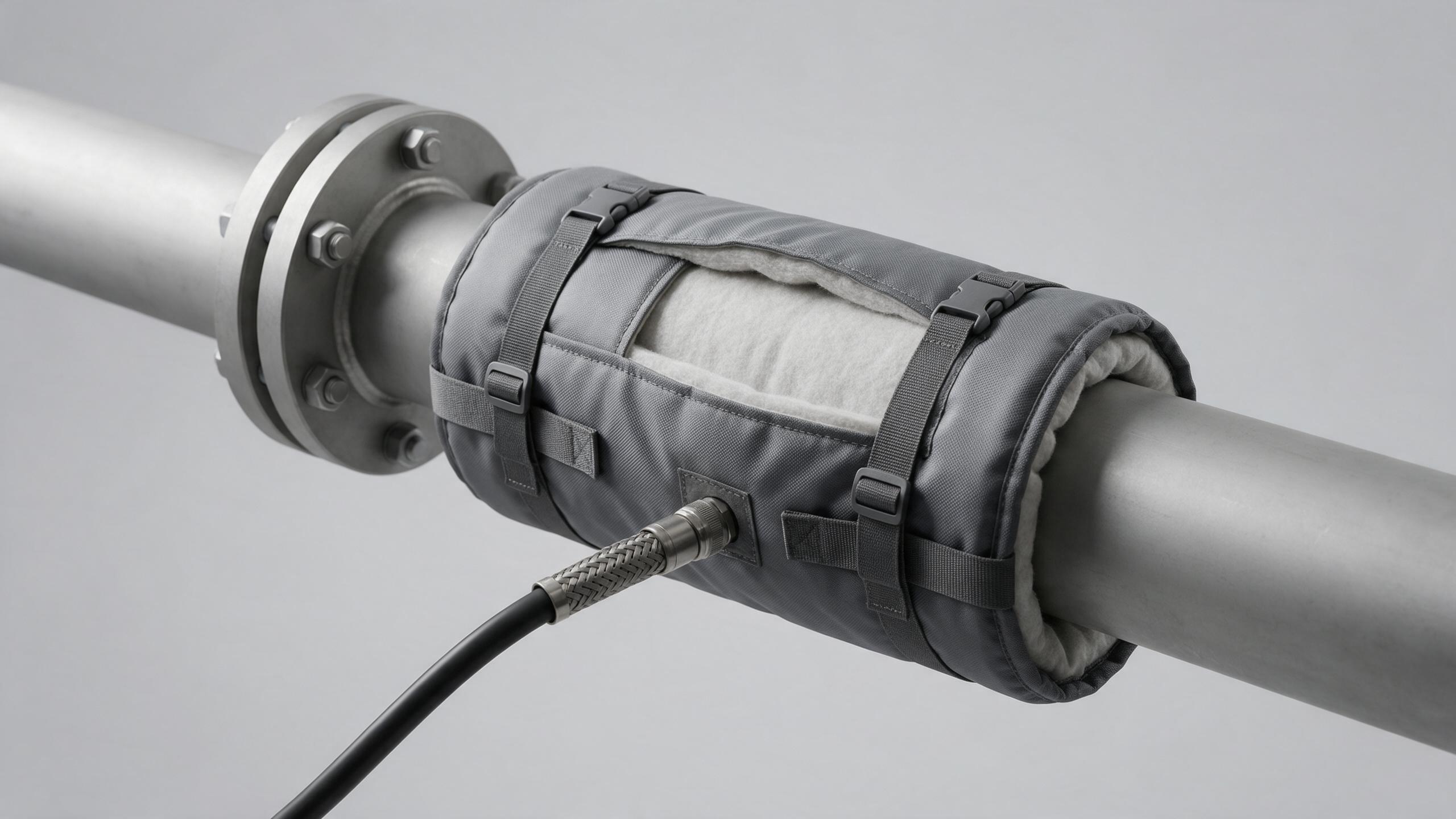
A wrapped heater commonly describes flexible heating tape, cable, or a generic wrap applied around a pipe. It can be a sensible approach where geometry is simple, access is limited, and the installation method is controlled. An industrial pipe heating jacket generally integrates a shaped heating layer with insulation and an outer cover, using closures designed for removal and refitting. Neither approach is inherently suitable for every line.
The difference becomes clearer when the pipe includes flanges, bends, instruments, supports, or frequent service points. A loose or repeatedly disturbed wrap can develop inconsistent contact, exposed sections, compressed insulation, or stressed lead exits. A tailored industrial pipe heating jacket can be designed around those interfaces, but its actual benefit still depends on material selection, closure design, installation practice, and inspection.
Why tailored construction can support a longer service life
1. Controlled fit reduces avoidable movement
Repeated movement is a practical durability issue. When a heater is secured only by field wrapping, it may shift as insulation is opened, piping vibrates, or technicians work around nearby components. A shaped industrial pipe heating jacket can place seams and closures clear of awkward interfaces and distribute retention across the assembly. That does not remove the need for careful installation; it reduces opportunities for the system to be pulled, pinched, or re-tensioned in an ad hoc way.
It is useful to distinguish good fit from excessive compression. Insulation that is crushed, wet, or poorly closed may lose its intended thermal behavior. During a review, ask where the closure lands, how the lead is supported, and whether the jacket can be removed without tugging the heating element.
2. The heater and insulation are handled as one assembly
With a basic wrap, heating cable, outer insulation, vapor protection, and fastening can be installed as separate layers by different people at different times. That may be appropriate, but each handoff introduces a condition to verify. In an industrial pipe heating jacket, the thermal layers are typically organized as a removable assembly. This can make the original layout easier to restore after inspection, particularly on recurring maintenance points.
ASTM C1695 addresses minimum property, design, and construction requirements for flexible removable and reusable blanket insulation for hot service. It is not evidence that any particular jacket meets that specification. It does, however, underline a useful purchasing principle: reusable insulation is a construction and securement question, not simply a thickness question.
3. Service access affects lifecycle wear
The most durable heating arrangement on paper can still have a short practical life if it must be cut, unwrapped, or improvised after every inspection. For lines with routine valve, sensor, or flange access, an industrial pipe heating jacket can help make removal and refitting repeatable. Operators should still document the orientation and check the closure after each intervention.
Maintenance convenience is not a cosmetic feature. It influences whether insulation is put back correctly, whether exposed sections are noticed, and whether a damaged lead or fastener is reported early. This is especially relevant where an industrial water chiller, process loop, or other temperature-control equipment is connected to piping that sees changing ambient conditions or operating cycles.
Compare the two options by failure mechanism, not marketing language
| Comparison point | What to examine | Why it affects service life |
|---|---|---|
| Geometry | Pipe diameter, elbows, flanges, branches, and instrument locations | Complex shapes increase the chance of gaps, tight bends, and disturbed layers. |
| Access cycle | How often the line is opened for inspection or repair | Repeated removal may favor a repeatable jacket layout over rewrapping. |
| Moisture exposure | Washdown, condensation, outdoor exposure, and sealing details | Moisture management can affect insulation condition, closures, and electrical inspection needs. |
| Lead routing | Strain relief, cable path, and clearance from moving or hot surfaces | A protected lead path reduces avoidable mechanical stress. |
| Control and verification | Temperature sensing, alarms, inspection records, and isolation procedure | Early observations can identify changing conditions before they become a larger maintenance task. |
Where trace-heating practice fits into the decision
IEEE 515 covers the testing, design, installation, and maintenance of electrical resistance trace heating for industrial applications. This does not turn a purchasing checklist into a compliance assessment. It does point to a sound habit: assess heating hardware, controls, installation, and maintenance together. If an industrial pipe heating jacket is paired with electrical heating, confirm the temperature class, circuit protection, sensor location, insulation condition, and inspection method for the actual site.
For a process linked to an industrial water chiller, the comparison may be more nuanced. The chiller may control one portion of the thermal loop while the pipe jacket manages local heat loss, viscosity, freeze exposure, or temperature stabilization elsewhere. The correct question is not whether a jacket replaces the chiller. It is whether the two control objectives, pipe materials, setpoints, and alarms are coordinated.
A practical evaluation checklist
- Document the pipe material, outside diameter, fittings, supports, and items that require access.
- Define the process objective: freeze protection, viscosity control, temperature hold, or another condition.
- Record normal and upset temperatures, expected heat loss, ambient exposure, and operating duration.
- Review whether the heating assembly will be removed routinely and who will refit it.
- Ask for construction details: insulation arrangement, outer covering, closure type, lead support, and cleaning limits.
- Plan inspection points for seams, fasteners, lead exits, sensor placement, moisture signs, and temperature trends.
This checklist also avoids a common procurement mistake: comparing only the delivered component. An industrial pipe heating jacket may be easier to maintain on a complex line, while a carefully installed wrap may remain appropriate on a stable, rarely accessed straight run. The decision should follow the operating conditions rather than a universal preference.
Conclusion: durability is a repeatability question
An industrial pipe heating jacket can outlast a wrapped arrangement when its tailored fit, protected layer stack, and repeatable removal process reduce avoidable handling damage. That outcome is conditional, not automatic. Before choosing, verify the thermal duty, geometry, access frequency, moisture conditions, electrical design, and maintenance procedure. A clear record of those inputs gives engineering and procurement teams a more reliable basis for judging lifecycle suitability.
 Hot News