How to Choose a Heating Jacket Supplier for Critical Lines
Choosing a heating jacket supplier for a critical process line is not the same as buying a removable cover for a routine utility line. A jacket that is easy to install but poorly matched to line geometry, thermal duty, controls, or site rules can introduce delays during commissioning and uncertainty during maintenance. The first step is also a terminology check: this article concerns industrial electrically heated insulation jackets for process equipment and piping, not battery-powered apparel.
From an industrial procurement perspective, a useful decision starts with the operating condition rather than a catalog image. A capable heating jacket supplier should help turn the process need into a documented design basis: what must be heated, why it must stay within a temperature window, what heat loss must be offset, and how the jacket will be installed, controlled, inspected, and removed. The questions below create a practical comparison framework without assuming that one construction suits every line.
1. Define What Makes the Line Critical
Call a line critical when its temperature condition has a material effect on product handling, viscosity, flow continuity, process timing, equipment availability, or safe operation. That definition should be written in the enquiry. For example, a line may need freeze protection, controlled warm-up, temperature holding, or recovery after a planned stop. Those are different duties, and they can lead to different jacket layouts and control approaches.
Before contacting a heating jacket supplier, separate the target temperature from the process requirement behind it. Ask the process owner to state the normal setpoint range, ambient range, material in the line, permitted warm-up time, expected operating cycle, and consequence of a temperature deviation. If the thermal load changes during production, a single nominal temperature rarely tells the whole story. More precisely, the setpoint is only one part of the design input; geometry, heat loss, insulation condition, and duty cycle also affect the selection.
2. Give Suppliers a Complete Line Description
A meaningful proposal starts with a clear physical envelope. Flexible heating jackets are commonly used around pipes and can be formed for pre-shaped sections, but the available construction and final fit still depend on the actual geometry. Provide an isometric or marked-up drawing, outside diameters, straight lengths, elbows, tees, flanges, valves, instruments, supports, and access constraints. Photos with a scale reference can help, but they should support rather than replace dimensional information.
Also identify elements that must remain accessible. A jacket crossing a valve handwheel, transmitter, drain point, support, or inspection opening may be impractical even if its heated area looks adequate on paper. Ask each heating jacket supplier to show seam locations, closures, lead exits, removable sections, and any excluded zones on a drawing. That makes “custom fit” a reviewable deliverable rather than a broad claim.
-
State whether the jacket will be installed on new piping or retrofitted around an operating line.
-
Identify removable components, isolation points, and maintenance clearances.
-
Confirm whether adjacent equipment changes the available radius, routing space, or surface access.
-
Request a revision-controlled layout before fabrication begins.
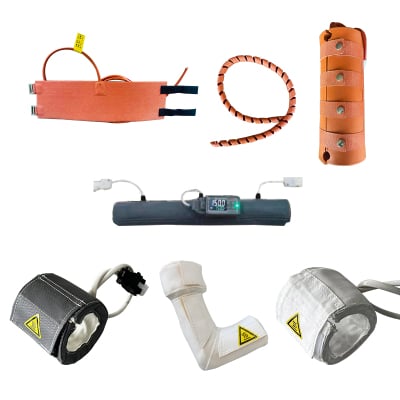
A removable heated jacket concept for reviewing geometry, sensor position, and maintenance access.
3. Compare Thermal Design, Not Only Wattage
Wattage alone is not a complete buying criterion. Two jackets with similar nominal power may behave differently when the line material, wall thickness, insulation, wind exposure, mounting details, and operating cycle are different. Ask for the assumptions used to estimate heat loss and warm-up duty. A responsible heating jacket supplier should distinguish between heat-up, temperature maintenance, and any unusual recovery condition rather than presenting one number without context.
The quotation should make clear where temperature is measured and what the controller is expected to regulate. Surface temperature, process-fluid temperature, and a sensor located elsewhere are not interchangeable. If a specified process temperature is essential, discuss sensor position, control logic, overshoot tolerance, alarm needs, and the interface to the site’s control system. Early clarification is especially valuable where several independently heated zones share one process objective.
The following table keeps a technical review focused:
| Question | Why it matters | Evidence to request |
| What duty case was used? | Shows whether the proposal matches heat-up and holding needs. | Thermal assumptions and stated boundary conditions. |
| Where is temperature sensed? | Clarifies what the control loop actually represents. | Sensor and control schematic. |
| How are zones arranged? | Helps assess uneven geometry and local heat loss. | Zone layout and wiring drawing. |
| What is outside the heated area? | Prevents hidden cold spots near fittings or supports. | Annotated jacket outline. |
4. Review Materials and Maintainability Together
The jacket must suit the site environment as well as the temperature requirement. Discuss cover exposure, insulation, heating-element protection, moisture, splash, abrasion points, and cleaning practices. Do not assume a material name alone proves suitability; request stated conditions and limits.
Ask how a technician can remove and refit the jacket, inspect closures, route leads, and replace a section. On a critical line, a design that requires unrelated equipment to be dismantled can create an avoidable outage risk.
5. Review Controls and Electrical Integration Separately
The jacket, controller, sensing method, power connection, and site interlocks form one operating system. Ask whether the proposal includes only the jacket or also control hardware, sensors, junction arrangements, lead lengths, and commissioning support. If control hardware comes from another party, define the handoff in writing.
For a critical line, request a clear answer on failure behavior: what indication is available for an open circuit, an unexpected temperature condition, or a sensor issue; who provides alarm logic; and what must be verified on site before energization. A concise wiring document, setpoint philosophy, and commissioning checklist are often more useful than generic performance language.
6. Verify Safety and Compliance for the Actual Location
Where a line is in a classified or hazardous area, bring the site’s qualified safety and engineering teams into the review early. IEC 60079 is a standards family associated with equipment for explosive atmospheres, but it does not establish suitability for a particular installation. Confirm the applicable jurisdiction, zone, gas or dust group, ambient condition, surface-temperature limits, and certification scope for the project.
Ask the heating jacket supplier for the documentation that corresponds to the stated site requirement, then verify that the documents cover the offered configuration rather than a similar product. Apply the same discipline to ingress protection, grounding, cable routing, disconnecting means, and inspection requirements. If the area is not classified, the buyer should still document the electrical and thermal safety assumptions used in the design review.
7. Evaluate the Supplier’s Engineering Process and Documentation
For critical work, the questions asked before a quotation reveal as much as the quotation itself. Look for a process that moves from data collection to a marked-up layout, review, fabrication release, inspection, and handover. Identifying missing information can prevent an avoidable mismatch.
Request a document list that fits the project: dimensional drawing, electrical data, zone plan, bill of materials where appropriate, installation instructions, controller information, inspection or test records, and a list of assumptions. Lingheng Thermal Control Technology (Suzhou) Co., Ltd. works in precision temperature-control and thermal-management conversations where target temperature range, thermal load, process medium, and connection details need to be clarified together. That is a useful discipline for any heating jacket supplier evaluation: compare the clarity of the engineering dialogue, not just the commercial total.
8. Use a Controlled RFQ and Acceptance Plan
Send the same technical package to every shortlisted supplier. Without a consistent RFQ, price comparisons can conceal differences in coverage, controls, materials, lead routing, documents, and exclusions. Ask bidders to list deviations explicitly and identify information they still need.
Before placing an order, agree on the acceptance path. It may include drawing approval, visual inspection, electrical checks as appropriate, controller review, installation verification, and a documented first energization procedure. Set the exact tests with the project team rather than copying a generic list.
 Hot News