What an LPCVD Heating Jacket Delivers for Low-Pressure Lines
An LPCVD heating jacket is an external thermal-control layer fitted around a gas or precursor delivery path. Its job is not to define the deposition recipe. Instead, this line-heating assembly helps the line hold a deliberate thermal condition between the source hardware and the process chamber. In low-pressure work, a small cold section, an exposed fitting, or uneven insulation can matter because the delivery path is part of the process system, not merely plumbing.
From an equipment-use and maintenance perspective, the useful question is not “does the LPCVD heating jacket get hot?” It is whether its temperature profile, mechanical fit, sensor feedback, and safety logic suit the actual line. That distinction helps a team avoid treating a heating jacket as a universal fix for unstable flow or film variation.
Why low-pressure lines need deliberate thermal control
LPCVD uses reduced pressure and elevated temperature to support vapor-phase deposition. General technical references describe broad LPCVD conditions from roughly 0.1 to 10 Torr and 200 to 800 °C, but those figures are process context, not an LPCVD heating jacket setpoint. The required line temperature depends on precursor behavior, process gas, source configuration, line geometry, pressure profile, and the chamber recipe.
A delivery line can lose heat at valves, elbows, supports, and access panels. If a temperature-sensitive vapor encounters a cooler surface, the vapor pressure and transport behavior can change. A properly specified LPCVD heating jacket is intended to reduce such temperature discontinuities across the covered section. It does not prove that a precursor is compatible with the line materials, nor does it compensate for leaks, restrictions, incorrect flow control, or an unsuitable source temperature.
What an LPCVD heating jacket can deliver
A more consistent thermal envelope
The primary delivery of an LPCVD heating jacket is controlled heat around a defined pipe section. With suitable insulation and sensor placement, it can help make the external thermal environment more uniform than an exposed run. This is especially relevant where a line passes through cooler equipment zones or where fittings create local heat-loss points. The value comes from stability and repeatability, not from selecting the highest possible temperature.
A clearer control boundary
A zoned LPCVD heating jacket can give engineers a practical way to separate source heating, line heating, and chamber heating in the control plan. Separate zones make it easier to investigate where a drift begins. For example, if a line sensor differs from a nearby surface reading, the response may involve insulation, sensor contact, wiring, controller tuning, or the physical layout rather than an immediate change to the process recipe.
Better access for inspection and service
Many heating-jacket designs are selected because they can be opened and refitted around complex line geometry. For an LPCVD heating jacket, that can simplify inspection of unions, valves, and tracing paths when maintenance planning permits it. The jacket still needs a fit review: closures must not obstruct service points, bend radii must remain acceptable, and the assembly must not place strain on sensors or electrical terminations.
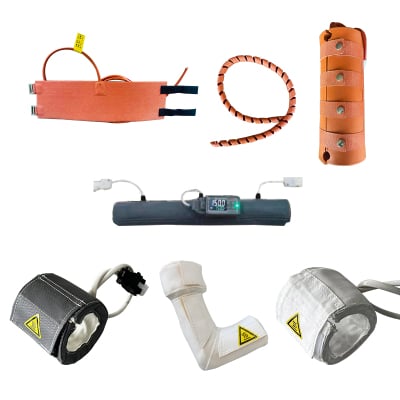
 An insulated line section with temperature monitoring illustrates the thermal-control concept.
How to assess an LPCVD heating jacket before installation
Start by mapping the actual heated length. An LPCVD heating jacket should be considered alongside every section that can influence the path: source outlet, regulator or mass-flow-control region, valves, elbows, filters, fittings, and the chamber entry. A short warm segment next to an uninsulated cold fitting may not provide the thermal continuity the process team expects.
- Temperature window: Define the intended surface or line-temperature range from the approved chemistry and tool documentation. Do not derive it from general LPCVD temperatures.
- Geometry: Record tube outside diameter, fitting locations, branch points, supports, and required maintenance clearance before sizing an LPCVD heating jacket.
- Control method: Specify sensor type, sensor location, controller accuracy, alarm behavior, and what happens after a power interruption.
- Materials and cleanliness: Review jacket, insulation, wiring, and closure materials against the facility’s contamination, outgassing, and chemical-compatibility requirements.
- Safety: Confirm over-temperature protection, grounding, electrical classification, guarding, and lockout practices with the responsible facility and EHS teams.
Commissioning checks that make the result measurable
Commissioning an LPCVD heating jacket should produce evidence, not just a controller display. First, verify that each zone responds to a controlled setpoint change and that independent measurements agree with the installed sensors within the project’s acceptance criteria. Next, inspect for cold interfaces around junctions and supports. Thermal imaging can be useful where facility rules allow it, but it should be interpreted with emissivity, access, and safety limits in mind.
Then observe temperature, pressure, and flow as a system. Precursor-delivery references emphasize that heating may influence vapor pressure and pressure drop through the delivery hardware; that is why an LPCVD heating jacket should be evaluated with flow and pressure signals rather than in isolation. During a controlled qualification run, document the line configuration, zone setpoints, actual readings, alarm status, and any recipe or hardware changes. This record helps distinguish a line-thermal issue from a valve, source, vacuum, or process-recipe issue.
Common assumptions to avoid
One assumption is that every low-pressure line requires the same LPCVD heating jacket. In practice, some gas paths may not need external heat, while others require carefully defined zoning. Another is that tighter wrapping automatically means better performance. Excessive compression can affect sensor contact, access, insulation behavior, or serviceability. A third assumption is that external heating can correct a chamber-side problem. It cannot replace recipe development, chamber calibration, leak checking, or conductance analysis.
It is also wise not to specify an LPCVD heating jacket solely from a nominal pipe size. The relevant decision package should include the chemistry’s approved temperature limits, the full line drawing, electrical requirements, desired control architecture, environmental constraints, and maintenance needs. Lingheng Thermal Control Technology (Suzhou) Co., Ltd. frames thermal-management discussions around process conditions, interfaces, and verification questions rather than isolated specifications; that approach is useful for this type of review.
A practical decision framework
For a low-pressure line, an LPCVD heating jacket delivers the most value when it is part of a documented thermal-management plan. Confirm the required temperature range first. Then compare the expected heat loss, line geometry, insulation strategy, sensor locations, controller functions, and safety provisions. Finally, define what data will show that the installation performs as intended.
The result is not a blanket claim of improved deposition. A correctly engineered LPCVD heating jacket gives a team a controllable, inspectable way to manage the thermal condition of a specified delivery section. That gives process, facilities, and maintenance personnel a clearer starting point for stable low-pressure operation and for troubleshooting when the line does not behave as expected.
 Hot News