
How to Verify Industrial Water Chiller Manufacturers
Choosing among industrial water chiller manufacturers is a procurement decision, not a directory exercise. A polished website or a low quotation does not show whether a supplier can meet your duty point, document the configuration, and support a clear acceptance process. This guide gives engineering, purchasing, and operations teams a practical way to verify industrial water chiller manufacturers before an order is released.
An industrial water chiller should be assessed as part of a system: process temperature, changing heat load, water quality, flow, installation conditions, electrical supply, and controls all affect suitability. Treat supplier claims as starting points, then ask for evidence that is relevant to your actual application.
Start with a verification brief
Before contacting industrial water chiller manufacturers, prepare a one-page brief. State the required supply-water temperature and tolerance, return-water temperature, expected flow, heat-load range, ambient conditions, utility limits, space restrictions, and preferred controls connection. If the load changes by production stage, describe the operating profile rather than submitting one average number. This makes quotes from industrial water chiller manufacturers easier to compare because every supplier is responding to the same conditions.
Include the fluid or water-treatment requirements, pipe connection expectations, startup constraints, and what records you need at delivery. A supplier may be technically capable yet still be a poor fit if its proposal leaves the operating boundary undefined.
Use a three-layer evidence test
A useful way to review industrial water chiller manufacturers is to separate claims into three layers:
- Claim: what the supplier says it can provide, such as a cooling duty or control function.
- Document: a dated specification, drawing, test procedure, certificate, component list, or quality record that explains the claim.
- Demonstration: factory-test evidence, a witnessed review, or commissioning records tied to agreed conditions.
Ask industrial water chiller manufacturers to label which items are standard, which are options, and which need engineering confirmation. That small distinction often exposes quotations that mix an indicative configuration with a committed scope.
Check the company and quality-document trail
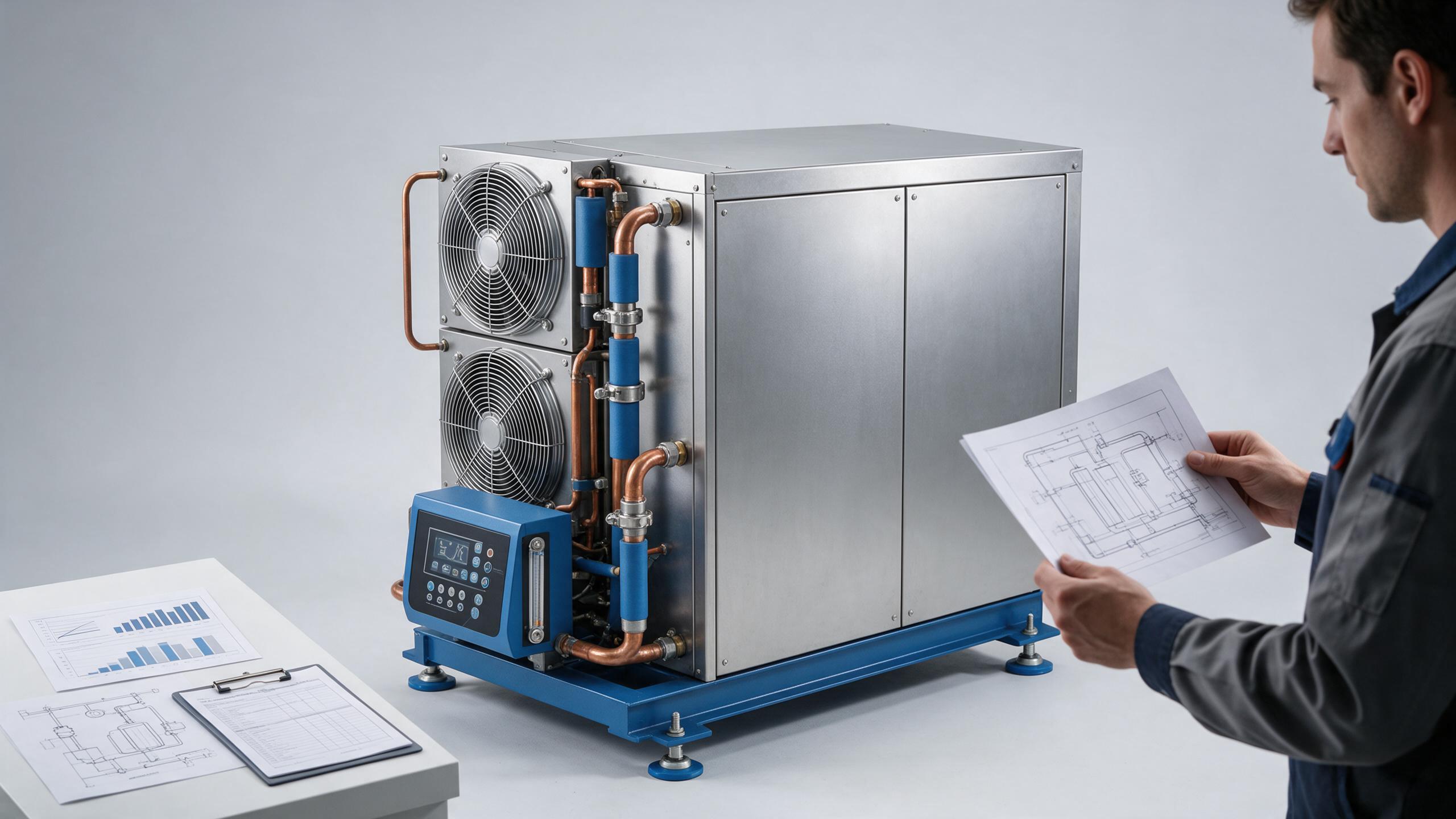
When comparing industrial water chiller manufacturers, request the legal manufacturing entity, production location, primary technical contact, and a current quality-management certificate if one is claimed. ISO 9001 is a quality-management-system standard; it can support a review of document control, but it does not by itself verify that a particular industrial water chiller will meet your process duty. Check the certificate issuer, scope, dates, and whether the named entity matches the contracting entity.
Then sample the supplier’s document discipline. Can it provide a revision-controlled datasheet, electrical drawing, piping diagram, bill of major components, operating manual outline, and inspection record? Reliable industrial water chiller manufacturers should be able to explain who approves changes and how the customer receives updated documents.
Validate the duty point instead of comparing headline capacity
Do not compare these suppliers using only a nominal capacity label. Ask each candidate to state the entering and leaving fluid temperatures, fluid flow, ambient condition, power supply, and allowable performance tolerance used for its selection. The same capacity figure can mean different things under different temperature or ambient assumptions.
For an proposed chiller, also ask how the proposal handles partial load, startup peaks, pump head, filtration, water quality, and temperature-control stability. The goal is not to force a supplier to promise a universal outcome. It is to identify the conditions under which its proposed unit is expected to operate and the inputs that still require confirmation.
Review design ownership and serviceability
Ask these suppliers which portions of the system they design, assemble, source, and test. A transparent answer should distinguish in-house engineering from purchased major components without turning a component brand into proof of whole-system suitability. Request the proposed maintenance access, routine inspection points, recommended spare parts, fault-history logging method, and remote-support boundaries.
For a long-lived proposed chiller installation, serviceability can change the practical cost of ownership. Review access clearances, draining and venting provisions, sensor replacement, pump isolation, and the information operators need to diagnose an alarm. These questions help compare these suppliers on execution rather than marketing language.
Make the factory acceptance test specific
Before selecting these suppliers, agree on a factory acceptance test, often called a FAT. The test plan should name the configuration to be tested, instruments to be used, stabilization time, temperature and flow readings, electrical readings, alarm checks, and the pass/fail method. Define which customer conditions can be reproduced at the factory and which must be verified after installation.
Commissioning guidance commonly frames verification as a documented process: define requirements, test against them, and retain records. Apply that logic to your supplier review. Ask these suppliers for the test procedure beforehand, not only a final statement that testing occurred. If a condition cannot be represented, record the limitation and plan a site check.
Run a commercial and technical comparison together
Create one comparison sheet for these suppliers, with evidence columns beside price. Useful rows include duty conditions, configuration boundaries, lead time assumptions, drawing approval, documentation, FAT scope, installation support, spares, warranty terms, and exceptions. Give each answer a status: documented, pending, conditional, or not offered.
This approach keeps a quotation from appearing more complete than it is. It also gives purchasing a clear path to resolve gaps with these suppliers before commercial negotiations are finalized.
Questions to send before purchase approval
- Which stated duty conditions were used to select this proposed chiller?
- What drawings and revision-controlled documents will we receive before production?
- Which performance items will be verified during the FAT, and how will they be recorded?
- What installation, water-quality, electrical, and controls-connection conditions remain customer responsibilities?
- Who manages technical changes after drawing approval?
- What routine maintenance access and spare-parts information are included?
- What site-acceptance checks should follow delivery?
Choose evidence, not a ranking
The practical way to evaluate these suppliers is to select the supplier whose documented scope, engineering responses, and test plan align with your project inputs. A supplier that asks disciplined questions about load, temperature, fluid, piping, and controls may provide more useful evidence than one that offers a fast generic answer.
For complex thermal-management work, keep the verification file with the purchase order. It becomes a shared reference for design review, factory testing, delivery, startup, and later maintenance. That record helps your team evaluate these suppliers on conditions that can actually be checked.


 Hot News