
What Is Battery Test Cooling and Why Is It Essential
Battery test cooling is the controlled removal or addition of heat while a cell, module, or pack is exercised on a test bench. It is not simply the cooling hardware installed in a vehicle. In a laboratory, battery test cooling creates a defined thermal boundary around the device under test so results can be compared across cycles, units, and test conditions.
From a thermal-management engineer’s perspective, the first question is not “how cold can the system go?” It is whether battery test cooling can hold the intended temperature while the electrical profile, heat load, coolant path, fixtures, and sensors all change. That distinction matters when a test result will inform design decisions, validation plans, or later investigations.
What does battery test cooling do?
At its core, battery test cooling moves heat between a temperature-control unit and the battery test article. A liquid loop may circulate conditioned coolant through a cold plate, fixture, or thermal connection. A controller compares a measured temperature with the setpoint, then adjusts refrigeration, heating, flow, or both. The aim of battery test cooling is to make thermal conditions known and repeatable rather than letting room conditions or previous cycling history shape the result.
Battery test cooling may be used during charge-discharge cycling, capacity characterization, durability work, environmental conditioning, and selected safety investigations. IEC 62660-1 addresses performance and life testing for lithium-ion cells used in electric road-vehicle propulsion, while IEC 62660-3 addresses safety-performance procedures and acceptance criteria for propulsion cells and cell blocks. These references do not prescribe one cooling architecture, but they illustrate why a clearly defined test condition is valuable.
Why temperature control changes test interpretation
Electrochemical behavior and internal resistance vary with temperature. If the device temperature drifts while current remains constant, a change in voltage response or available capacity may reflect the thermal condition as much as the cell itself. Battery test cooling helps separate those influences by holding the planned thermal environment as closely as the fixture and test profile allow.
The value is especially clear when heat generation is not steady. A drive-cycle pulse, fast-charge segment, or repeated load sequence can create a changing heat load. An industrial chiller sized only for average heat removal may allow the fixture temperature to move during peaks. For battery test cooling, engineers therefore examine the full heat-load profile, not only a single nominal value.
Battery test cooling versus onboard battery cooling
Onboard cooling is designed to manage a battery in a vehicle or machine during use. Battery test cooling is designed to establish and document laboratory conditions around a test article. The two systems may use related ideas—coolant circuits, heat exchangers, pumps, and controls—but their acceptance criteria differ.
- Onboard systems are evaluated for operation within a vehicle architecture and real-world duty cycles.
- Battery test cooling is evaluated for setpoint stability, response to programmed loads, uniformity at relevant measurement points, and traceable test records.
- Test fixtures must also account for contact resistance, insulation, hose routing, sensor placement, and the delay between coolant and cell temperatures.
In other words, a stable coolant outlet reading is useful, but it does not by itself prove stable device temperature. The measurement plan needs to show what temperature is being controlled and where it is being observed.
What a battery test cooling loop includes
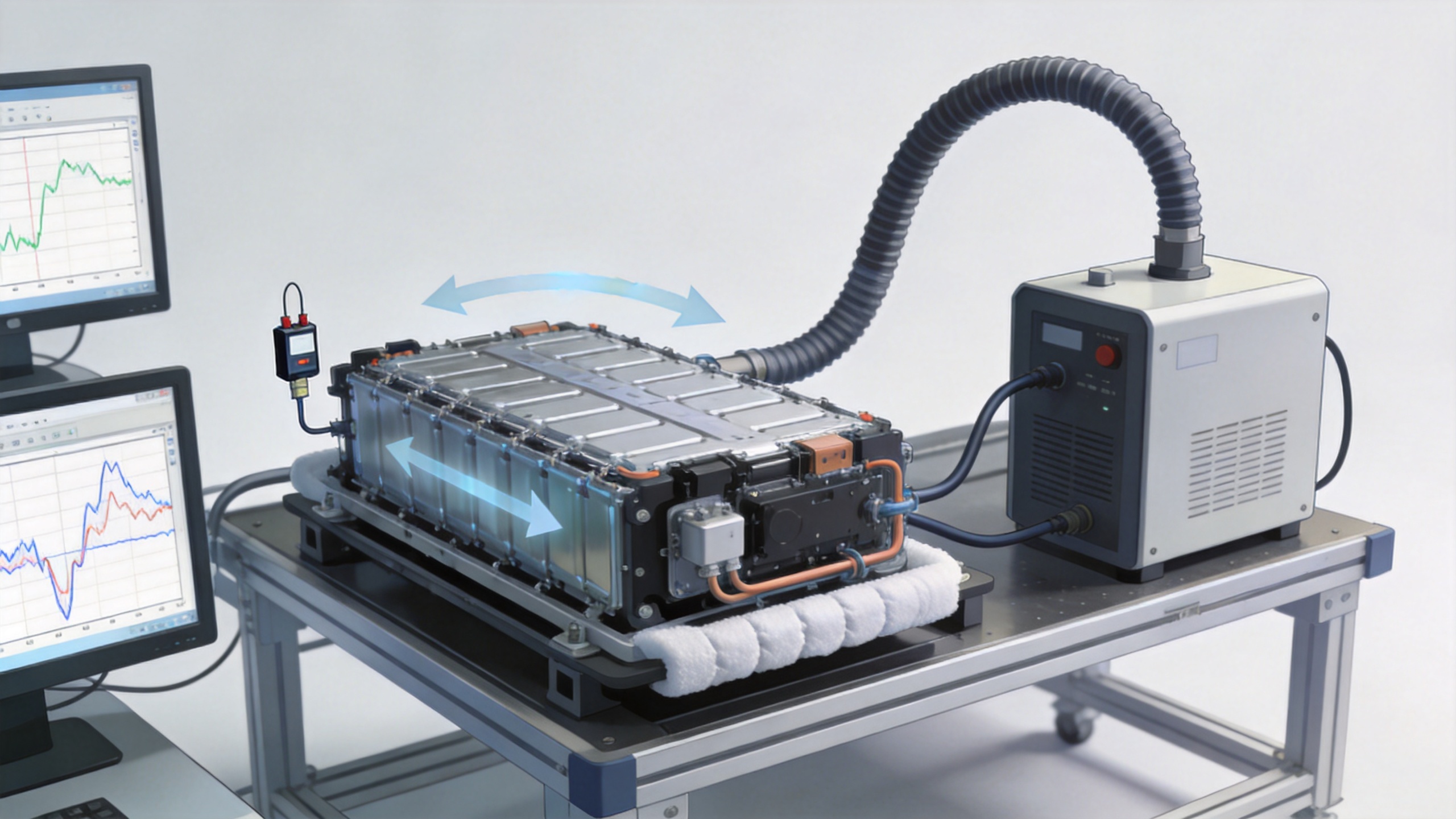
A typical battery test cooling setup includes a temperature-control unit, a pump, supply and return lines, a heat-transfer connection, temperature sensors, flow monitoring, and communication with the cycler or test controller. Depending on the test, it may also need heating capacity. A combined heating-and-cooling approach can be useful when a sequence crosses setpoints or when the laboratory must return the article to a defined starting condition.
The industrial chiller is one part of this loop, not the whole answer. Its usable capacity depends on target temperature, ambient conditions, coolant properties, pressure drop, and how quickly the test profile changes. Before selecting equipment, teams should map the expected heat input, allowable temperature deviation, required flow, connection sizes, electrical supply, and control signals.
Four checks that make the setup more credible
- Define the control point. State whether battery test cooling controls supply coolant, return coolant, a cold plate, a chamber, or a temperature measured on the test article.
- Capture transient demand. Use the planned current profile to identify peaks, dwell periods, and reversals. If heat load changes sharply, response behavior matters as much as steady capacity.
- Check temperature uniformity. Place sensors where gradients are plausible, especially across larger modules or at locations distant from the fluid inlet. A single convenient sensor can hide a meaningful difference.
- Verify system integration. Confirm interlocks, alarms, flow status, data logging, and the response to a cycler pause or fault. This is where battery test cooling becomes part of a controlled test method rather than standalone utility equipment.
When should an industrial chiller be considered?
An industrial chiller is often considered when the test fixture needs a recirculating liquid loop, repeatable setpoints, and sufficient heat rejection over long cycling sequences. It should be evaluated against the actual test envelope, not selected from a headline capacity alone. If the application includes low-temperature conditioning, high flow resistance, or alternating heating and cooling, those conditions should be identified early.
SAE J2464 describes a body of tests that may be used to assess abuse responses of electric and hybrid-electric rechargeable energy-storage systems. That broader context reinforces a practical rule: battery test cooling should be sized and controlled for the defined test scenario. Routine cycling, thermal characterization, and abuse-related work can place very different demands on the same laboratory infrastructure.
A practical starting checklist
Before commissioning battery test cooling, document the temperature range, test duration, maximum and changing heat load, coolant type, permitted temperature deviation, target flow, fixture pressure drop, sensor locations, ambient conditions, and required control connection. Then run a representative profile and compare coolant readings with temperatures at the test article. If the gap is larger or slower to settle than the method permits, adjust the connection, flow, controls, or test sequence before treating the electrical data as comparable.
Battery test cooling is essential because it turns temperature from an uncontrolled influence into a recorded test condition. With the right thermal boundary and verification plan, teams can interpret battery data with greater confidence and identify where further fixture or method refinement is needed.
How to write a battery test cooling requirement
A battery test cooling requirement should begin with the method, not a catalogue. Specify the control point, setpoint, permitted deviation, starting condition, and duration. Then describe the current profile, including peaks, rest periods, and state-of-charge window. This tells the test team whether battery test cooling faces a steady or changing thermal load.
Battery test cooling commissioning log
| Check | What to record |
|---|---|
| Battery test cooling control point | Identify coolant supply, coolant return, fixture surface, or battery-surface measurement. |
| Battery test cooling stability | Log setpoint and measured temperature through a representative electrical profile. |
| Battery test cooling response | Compare settling behavior after a pulse, dwell, or programmed temperature change. |
| Battery test cooling uniformity | Use sensors at locations where a module or fixture could develop a gradient. |
| Battery test cooling traceability | Store temperature, flow, alarm, and cycler status on the same time base. |
| Battery test cooling restart | Check the return to the intended starting condition after a realistic pause. |
| Industrial chiller range | Confirm the industrial chiller can operate at the selected coolant range and ambient condition. |
| Industrial chiller flow | Confirm industrial chiller flow against fixture resistance, hoses, and connections. |
| Industrial chiller capacity | Compare industrial chiller capacity with the changing heat-load curve, not only an average. |
| Industrial chiller control | Check how the industrial chiller responds when the cycler pauses or a flow alarm occurs. |
| Industrial chiller service | Document industrial chiller utilities, drainage, access, and coolant-maintenance needs. |
The record should make battery test cooling auditable. During commissioning, compare battery test cooling setpoint, supply, return, fixture, and battery-surface readings. If those traces separate beyond the method limit, revise the thermal contact, flow, sensor plan, or control logic. That review prevents a stable industrial chiller display from being mistaken for stable battery temperature.
Revisit battery test cooling when the cell format, fixture, coolant, target range, or test current changes. A small change can alter thermal resistance or the load seen by an industrial chiller. Maintaining a consistent battery test cooling log makes cross-test comparisons more useful and gives investigators context when electrical data shifts.
 Hot News