
What Temperature Control Does a Pipe Heating System Offer for Gas Lines?
A pipe heating system for a gas line is not simply a cable that makes a pipe warm. It is a control arrangement intended to offset heat loss, maintain a defined operating condition, or reduce the likelihood of unwanted cooling at a specific part of the line. The usable temperature control depends on the heating technology, sensor location, insulation, pipe construction, ambient conditions, and the gas service. In locations where a flammable atmosphere may be present, area classification and the approved system design also set non-negotiable limits.
From a thermal-management application-engineering perspective, the right question is not “What temperature can a pipe heating system reach?” It is “What temperature must this line maintain, under what heat loss, and how will the system verify it?” That distinction prevents a nominal temperature rating from being treated as a site-specific promise.
What does temperature control mean on a gas line?
For many installations, a pipe heating system provides one or more of three control functions. First, it can maintain a minimum pipe-wall or process temperature. Second, it can compensate for changing heat loss as weather, wind, insulation condition, or line exposure changes. Third, it can limit temperature so that the heater does not drive the pipe or surrounding equipment beyond the design condition. These functions may be combined, but they are not interchangeable.
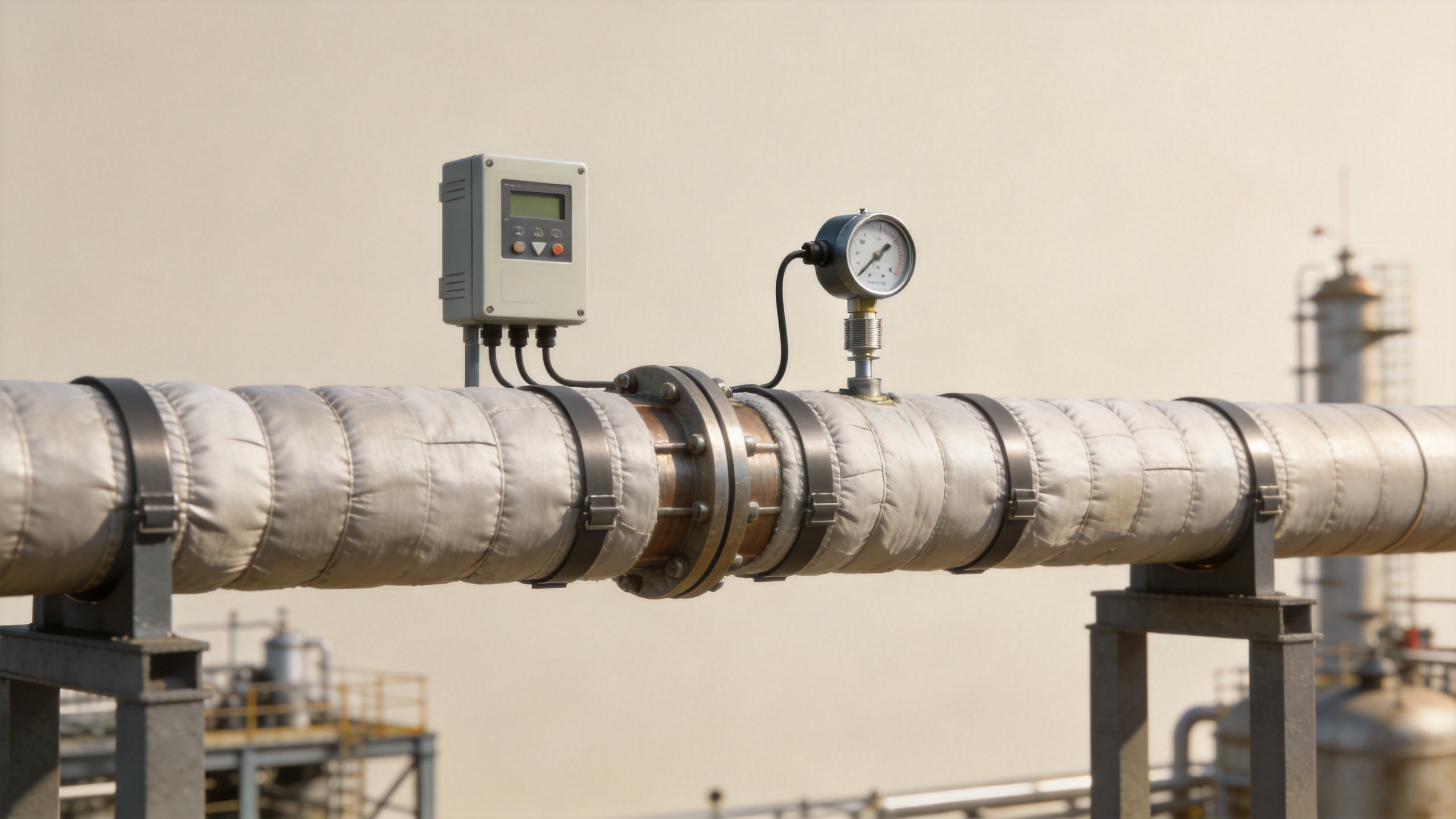
A basic arrangement uses a thermostat. When the sensor sees a temperature below the selected setpoint, the controller energizes the circuit; when the sensed temperature recovers, it switches the circuit off. This gives on/off maintenance control. The actual pipe temperature will normally move through a control band rather than remain at one mathematically exact value. The size of that band depends on sensor response, controller differential, thermal mass, heater output, insulation, and the delay between heat input and the sensing point.
A more capable pipe heating system can use an electronic controller with a pipe-surface sensor, ambient sensor, or both. That controller may display temperature, alarm when a reading is outside a selected range, detect some sensor faults, schedule operating periods, or communicate a status signal to a plant control system. Such functions improve visibility, but they must be matched to the actual control objective and approved installation practice.
How the common control approaches differ
Self-regulating heating cable
Self-regulating cable changes its heat output in response to local conditions along the cable. Colder sections generally receive more output, while warmer sections receive less. This behavior can help a pipe heating system respond to uneven exposure around fittings, supports, or outdoor runs. However, self-regulation is not the same as precise process-temperature control. A separate thermostat or electronic controller may still be needed when the project requires a defined maintenance temperature, documented alarm point, or energy-management logic.
Constant-wattage or series-resistance heating
Constant-wattage designs typically deliver a more fixed heating output per unit length under stated conditions. For these systems, a pipe heating system commonly relies on a controller and properly placed sensor to determine when the circuit operates. This can be suitable where calculated heat loss, circuit layout, and the desired temperature range are known, but it also makes the control and limiting strategy especially important. Do not assume the cable rating alone establishes the gas-line temperature.
Pipe-surface versus ambient sensing
Ambient sensing reacts to outside air temperature and can be useful for freeze-protection or seasonal operation. Pipe-surface sensing responds more directly to the line condition, so it is often better aligned with a maintenance-temperature objective. A pipe heating system may use ambient sensing for enable/disable logic and pipe sensing for control or alarm functions. The sensor must be secured at a representative location, protected from false heat paths, and covered by insulation as required by the design. A sensor placed beside a heater overlap, an uninsulated valve, or a local cold bridge may not represent the condition that matters.
What temperature can a pipe heating system maintain?
There is no responsible single temperature answer for every gas line. A pipe heating system can be designed around a selected setpoint or temperature range, but whether it maintains that target depends on the heat balance. The design team must consider pipe diameter and material, run length, insulation thickness and condition, minimum ambient temperature, wind, supports, valves, heat sinks, supply voltage, circuit loading, and the required warm-up time.
Gas composition and pressure conditions also matter. In some services, the objective may be to avoid low-temperature operating problems at a regulator, meter, analyzer, drain point, or instrument connection rather than to heat the entire pipe uniformly. In other services, the line may have an upper-temperature limit driven by components, seals, coatings, or safety analysis. More heat is not automatically better. The right pipe heating system is one that maintains the verified condition while respecting the lowest applicable temperature limit.
Why limiting control matters for gas-service applications
For gas lines, temperature control is also a safety and compliance subject. If the installation is in or near a classified area, the heater, controller, junction boxes, sensors, wiring method, and protection approach must be selected for that area and the applicable project rules. A high-temperature limiter may be separate from the normal controller. Its job is not to optimize the setpoint; it is to de-energize the circuit when a verified limiting temperature is reached or when the protection strategy requires a shutdown.
That distinction is important: normal control handles routine heat demand, while limiting control addresses an abnormal condition. A pipe heating system should not be represented as suitable for hazardous gas service until the relevant classification, temperature class, equipment approvals, installation details, and governing requirements have been confirmed by qualified personnel. This article describes selection logic, not a substitute for a hazardous-area design review.
Where an industrial heating jacket fits
An industrial heating jacket or removable pipe heating jacket may be considered for localized equipment, valves, analyzers, or sections that benefit from removable heat input. A heating jacket can be convenient where access is needed, but its control quality still depends on contact, coverage, insulation, sensor placement, and the allowed surface temperature. It should be evaluated as part of the same thermal and safety design, rather than as an isolated accessory.
A practical control-selection checklist
- State the required minimum, normal, and maximum allowable temperatures.
- Identify whether the goal is freeze protection, temperature maintenance, process stability, or warm-up.
- Calculate heat loss for the worst credible ambient and installation conditions.
- Choose whether the pipe heating system needs ambient sensing, pipe sensing, electronic control, alarms, or a high-temperature limiter.
- Map sensors, terminations, valves, supports, and insulation boundaries before assigning control points.
- Confirm hazardous-area classification, temperature limits, applicable approvals, and installation requirements before procurement.
- Plan commissioning checks for sensor response, setpoint behavior, alarm action, and insulation reinstatement.
The useful answer: controlled temperature, not a generic rating
A pipe heating system can offer simple thermostat switching, locally responsive self-regulating behavior, electronic setpoint control, alarms, and independent limiting functions. Which combination is appropriate for a gas line depends on the required operating condition and the installation constraints. Start with heat loss, target temperature, sensor location, and safety classification. Then validate the selected pipe heating system against the pipe, insulation, controls, and approved project documentation. That approach produces a more reliable answer than choosing a heater by temperature rating alone.
 Hot News