
How a Pipe Heating System Keeps Precursors Vaporized for Deposition
In a deposition tool, a precursor may leave its source in a usable vapor state and still arrive at the chamber in the wrong condition. The reason is often simple: somewhere between the source, vaporizer, valve manifold, and chamber inlet, a surface is colder than the vapor can tolerate. A properly engineered pipe heating system is intended to prevent that interruption. It maintains a controlled thermal path so the precursor is less likely to condense, fractionate, or create an unstable dose before it reaches the process.
From a semiconductor equipment integration perspective, the important point is that a pipe heating system is not merely a warm cable around tubing. It is a coordinated assembly of heaters, insulation, sensors, controllers, fittings, and commissioning practices. The appropriate temperature is material- and process-specific; it must preserve enough vapor pressure for delivery while remaining below the precursor’s thermal-stability boundary.
Why precursor transport needs controlled heat
CVD and ALD processes rely on vapor-phase delivery. Many precursor chemistries have modest vapor pressure at room temperature, so heating may be used at the source or vaporizer to create a usable vapor stream. Once that stream enters a transfer line, heat loss to the ambient environment can lower the wall temperature. If the local temperature falls below conditions needed to keep the material in the vapor phase at the local pressure, material can condense on the wall.
A pipe heating system addresses this risk by establishing a stable temperature envelope along the full wetted path. The goal is not maximum temperature. The goal is an even, validated temperature profile with enough margin above the local condensation tendency and enough margin below a chemistry’s known decomposition or reaction limits. That distinction matters: excessive heat can be as harmful as a cold spot.
This is why a blanket setpoint copied from a different tool is rarely a sound starting point. Vapor pressure, carrier-gas flow, line pressure, tubing diameter, duty cycle, precursor purity, and valve geometry all influence the usable window. Engineering teams normally begin with the chemical supplier’s handling guidance and then validate the full delivery system under representative process conditions.
What happens when a line develops a cold spot
A cold spot is any local section whose actual surface temperature is lower than the intended control band. It can appear at an uninsulated fitting, a valve body, a tee, a clamp, a long unsupported run, or a section near a cabinet wall. A pipe heating system may show a reasonable controller reading while a nearby component remains colder because the sensor is not located at the limiting point.
When vapor condenses, the immediate consequence may be reduced material delivery. The longer-term consequence can be less predictable: retained liquid or solid can later revaporize, altering a subsequent pulse or dose. In a deposition process, that variability may show up as unstable film growth, composition drift, particle risk, delayed stabilization, or difficult troubleshooting. These outcomes are process-dependent, but the system-level principle is consistent: a discontinuity in thermal control can become a discontinuity in delivery.
For this reason, a pipe heating system should be reviewed as a continuous thermal circuit rather than as a collection of individual heater zones. The vaporizer may be stable, but its performance cannot compensate indefinitely for a cold valve block downstream.
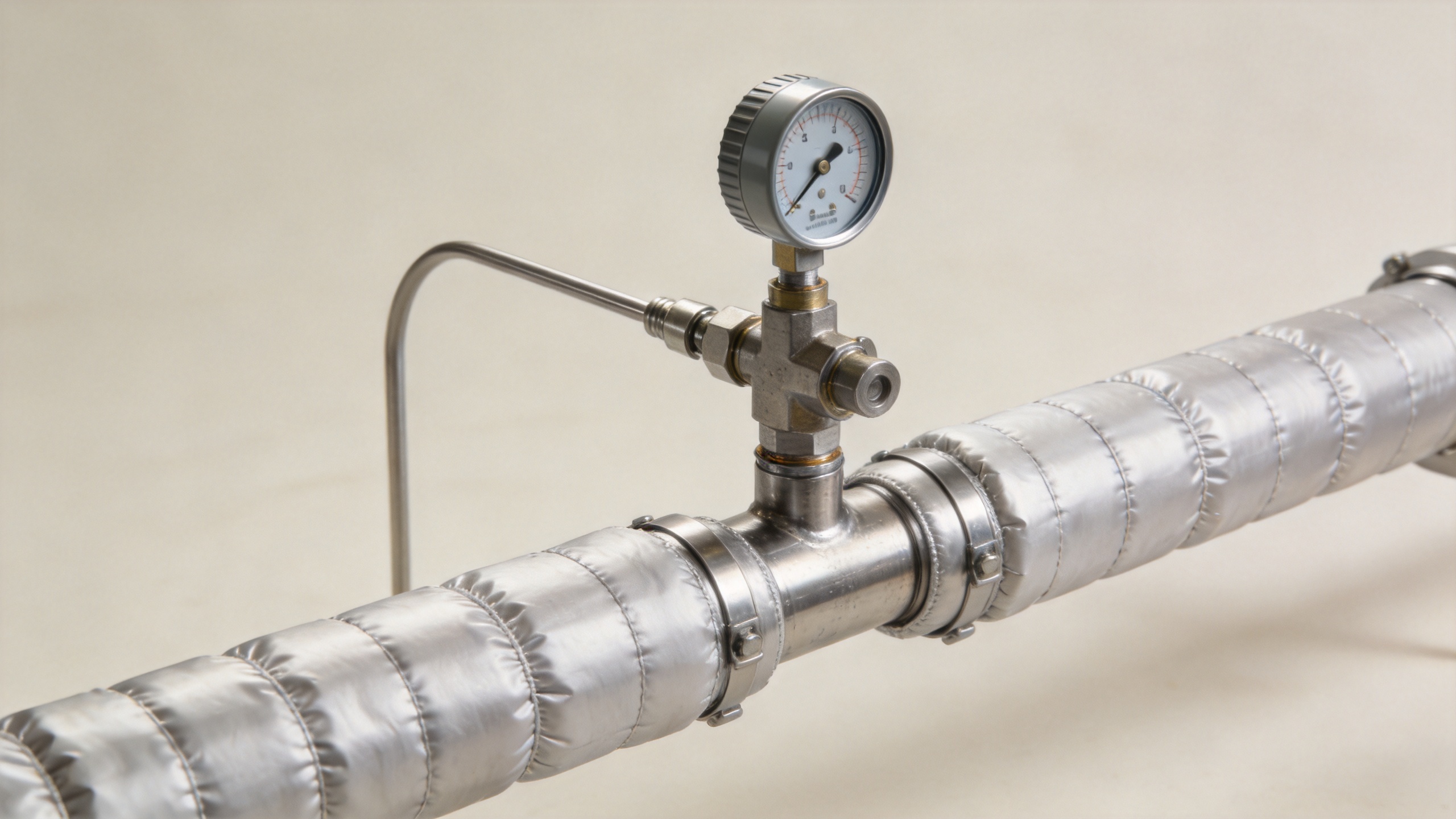
How the main elements work together
Heater and pipe heating jacket
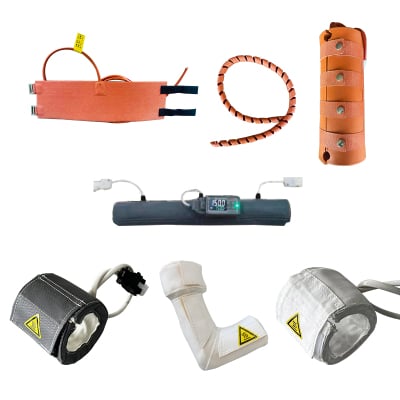
The heater supplies energy to offset losses from the tubing and attached hardware. A flexible pipe heating jacket can provide close contact around a line, especially where conventional rigid heating is impractical. Its value depends on coverage, contact quality, bend management, compatibility with the installation, and its relationship to the line’s temperature-control strategy. Gaps around fittings or poorly seated sections can reduce the benefit of an otherwise suitable pipe heating jacket.
Insulation and external heat loss
Insulation reduces the heater power required to hold a setpoint and helps smooth temperature variations caused by airflow, cabinet openings, or changes in ambient conditions. It does not replace control. Rather, insulation lets a pipe heating system maintain the required line temperature with less sensitivity to local disturbance. It must also be applied without obstructing service access or creating uninspected areas at components that are prone to heat loss.
Sensors, controllers, and limits
Temperature sensors close the control loop, but their location determines what the controller actually knows. One sensor on a long run may not reveal the coldest fitting. A robust pipe heating system often divides critical routes into logical zones, locates sensing near risk points, and uses high-temperature limits independent of the normal control loop. The limit is a safeguard, not a substitute for a validated thermal design.
Interfaces and materials
Every connection deserves review. A heated line can lose heat into a larger metal valve, a support bracket, or a transition to an unheated component. Materials, seals, electrical routing, grounding requirements, cleaning practices, and maintenance access should be verified for the intended temperature range. An industrial heating jacket must be selected for the actual geometry and environment, not only for a nominal wattage value.
Setting temperature without overheating the precursor
The useful setpoint is a process decision, not a generic heating recommendation. A practical approach is to define the source temperature, vaporizer temperature where applicable, transfer-line temperature, valve-zone temperature, and chamber-interface temperature as one profile. The profile should be justified by the precursor’s vapor-pressure behavior and thermal-stability data, then confirmed with measurements at the points most likely to cool.
In educational ALD material, some low-vapor-pressure precursor systems are discussed in the context of dosing at roughly 100–1000 mTorr or more. That is an illustrative condition rather than a universal target. It does, however, explain why a pipe heating system is important: an apparently small temperature reduction can change available vapor pressure enough to affect transport.
A good commissioning record includes target values, acceptable deviation bands, sensor locations, ambient conditions, controller tuning, heat-up time, and observations during representative flow. If a temperature is stable only when the cabinet door is closed, or only at one carrier-gas rate, the system has not yet demonstrated a robust operating window.
Where heating jackets fit in the design
A heating jacket is useful when a line, valve, cylinder connection, or irregular component needs close-coupled, removable heat. A pipe heating jacket is a specific form of that approach for transfer tubing and can be paired with insulation to improve uniformity. An industrial heating jacket may be appropriate where construction, temperature capability, environmental protection, electrical certification, or serviceability needs differ from laboratory-scale hardware.
Still, a heating jacket should not be treated as a cure-all. It cannot correct a poorly chosen routing path, an unheated dead leg, inappropriate sensor placement, or a precursor operated outside its stable range. It is most effective as part of a documented pipe heating system in which every thermally significant component is considered.
A commissioning checklist for deposition transfer lines
- Map the full precursor path, including fittings, valves, tees, supports, and the chamber interface.
- Define the required temperature profile from verified precursor and process information.
- Identify likely cold spots before insulating the line; do not assume a single sensor represents every surface.
- Confirm heater coverage and contact at bends, interfaces, and sections using a pipe heating jacket.
- Check insulation continuity while preserving access for inspection and maintenance.
- Validate normal control, over-temperature limits, alarms, electrical protection, and safe shutdown behavior.
- Document results under representative flow, pressure, and ambient conditions rather than at idle only.
The practical takeaway
A reliable pipe heating system keeps precursor transport predictable by treating temperature as a controlled path instead of a single setpoint. A dependable result comes from matching the thermal profile to the chemistry, reducing cold spots at real interfaces, measuring the right locations, and validating the assembly under process-like conditions. When those elements work together, a pipe heating jacket, an industrial heating jacket, and the associated controls become part of a stable precursor-delivery strategy rather than isolated pieces of hardware.
 Hot News