
Why a Heating Jacket Beats Wrapped Heaters for Gas Lines
For a gas line, a heating jacket is not simply a warmer covering. It is a removable thermal assembly that should be considered alongside the heat source, insulation, control method, pipe geometry, and area classification. That distinction matters because a gas-line decision is rarely about making a pipe feel warm. It is about managing heat loss, avoiding cold spots, and keeping service access practical.
From a thermal-management application engineer’s perspective, the first question is not “jacket or wrap?” It is what temperature must the line maintain, what medium and pressure conditions apply, how much heat is lost at fittings, and whether the installation sits in a classified location. Once those conditions are clear, an industrial heating jacket often gives a more repeatable and maintainable answer than a field-wrapped heater arrangement.
Wrapped heaters and heating jackets solve different installation problems
A wrapped heater usually describes a heating element, tape, cable, or flexible band installed directly around a pipe and then covered with insulation or protective layers. It can suit long, straight, accessible runs engineered as a complete heat-trace system. Its results still depend on cable spacing, contact, overlaps, insulation fit, weather protection, and access after installation.
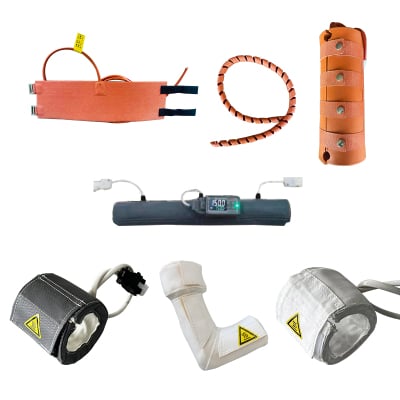
A heating jacket, by comparison, is a purpose-made removable enclosure that fits a defined pipe section, valve, flange, regulator, meter, or other awkward geometry. Depending on the application, the jacket may provide insulation over a separately designed heat-trace system or integrate controlled heating into its own construction. These are not interchangeable configurations, so the supplier and project team should make that boundary explicit before selecting a solution.
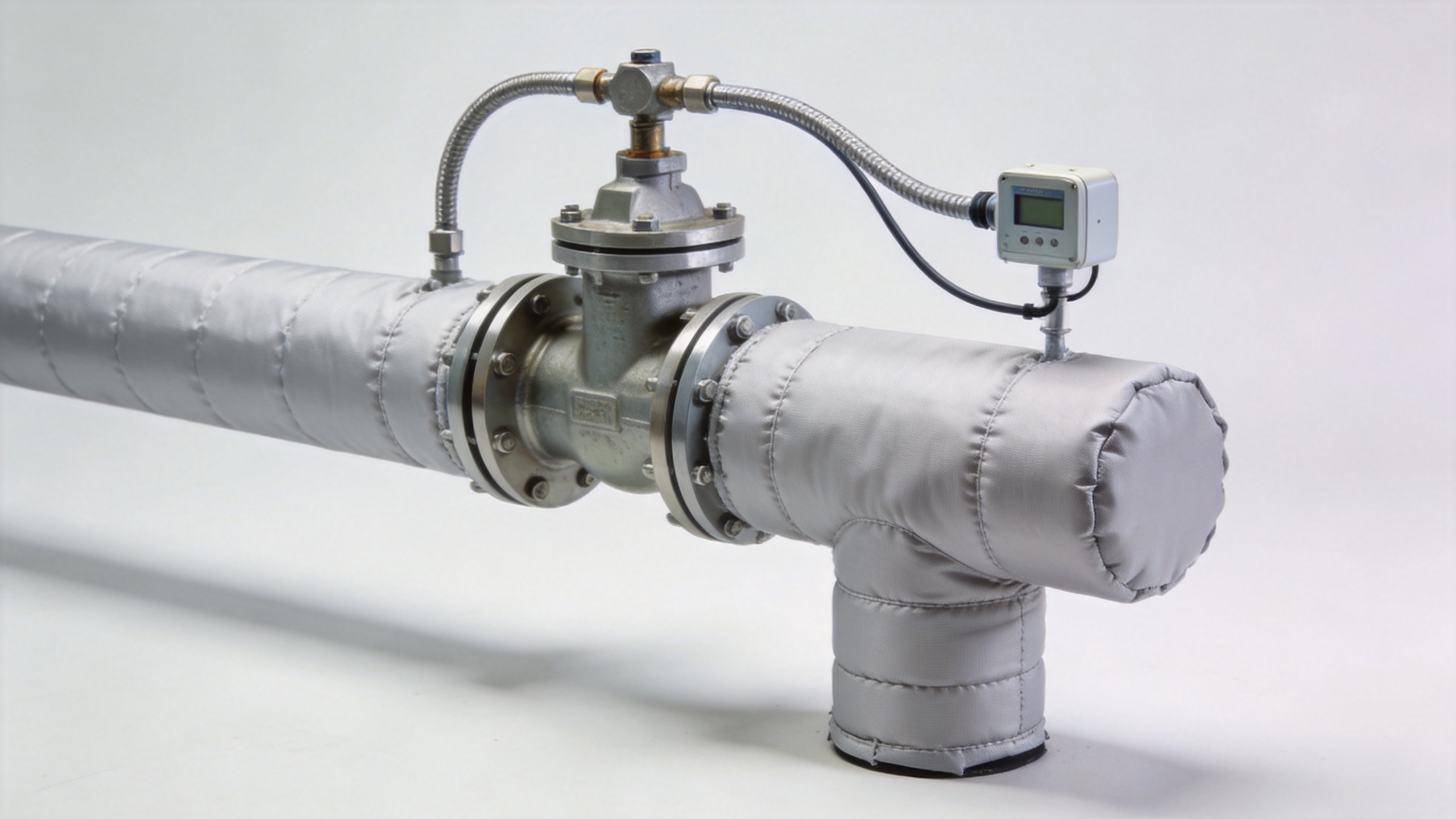
For gas lines, this difference becomes visible at the locations that need attention most: valves, branches, flanges, supports, instruments, and short exposed spools. A field wrap can be difficult to lay uniformly around irregular hardware. A well-specified pipe heating jacket can be patterned around that hardware and removed when inspection or maintenance is required.
Why a heating jacket can be the better choice on gas lines
1. More controlled coverage around complex geometry
Heat leaves a pipe through the full surface area, not only through the straight run. Flanges, valve bodies, reducers, and instrument takeoffs often create geometry where conventional wrapping becomes inconsistent. Gaps, compression points, or a poorly refitted insulation layer can change local heat loss. A fitted heating jacket gives the design team a defined coverage zone and fastening method instead of relying entirely on installation technique at each service point.
That does not mean every jacket automatically produces uniform pipe-wall temperature. Uniformity still depends on heater placement, insulation thickness, ambient conditions, contact arrangement, control logic, and process duty. The practical advantage is easier specification and inspection of coverage and removal.
2. Better service access without treating insulation as disposable
Gas-line components eventually need attention. Technicians may need to reach a valve, inspect a joint, check an instrument, or replace a component. With a wrapped arrangement, insulation and protective layers may be cut back and rebuilt after each intervention.
A removable pipe heating jacket lets the team open the same section, complete the work, and reinstall the enclosure without rebuilding a wrap from scratch. This is especially useful where maintenance access is routine or where the geometry would make repeat wrapping slow and inconsistent. Before specifying one, confirm fasteners, handling requirements, clearance around controls, and outer-surface condition after repeated removal.
3. A clearer path to thermal-system verification
Insulation is part of heat-trace performance, not an afterthought. Industry guidance commonly describes insulation over heat trace as a way to retain heat at the pipe and reduce exposure to hot surfaces. For a gas-line application, the relevant question is how the complete assembly limits heat loss under the real ambient, wind, moisture, and operating-cycle conditions.
A heating jacket helps organize that verification conversation. The team can document covered equipment, construction, insulation boundaries, heater interface, sensor location, controller setpoint, and permissible surface temperatures. A wrap can also be designed this way, but field changes can obscure those details.
4. Less dependence on installation consistency at localized trouble spots
Long straight pipe often suits a continuous heat-trace design. Localized components are different. A controller, pressure regulator, valve station, or meter run may need a tailored enclosure rather than several improvised transitions between wrap, insulation, and cladding. A pipe heater jacket can reduce those transitions when it is designed for the actual component shape.
This is a matching advantage, not a blanket claim that jackets are inherently superior. For a simple, continuously routed pipe with stable access, a properly engineered wrapped system may be the more economical and practical solution. The jacket is strongest where geometry, removal, and repeatable coverage are the constraints.
Where wrapped heaters can still be the right choice
It is useful to be precise: an industrial heating jacket does not replace every wrapped heater. Wrapped heat tracing may remain appropriate when the heated length is long, the pipe routing is regular, the heating circuit needs to continue across many sections, and service access is limited to planned outages. It can also make sense when the engineering package already defines cable type, circuit length, insulation, controls, and installation details for the entire run.
The decision changes when the line includes components that must be opened repeatedly or when the thermal weak point is a short irregular section rather than the full pipe. In those cases, a removable jacket can complement—not necessarily replace—the main heat-trace system.
A practical comparison for a gas-line project
| Selection factor | Heating jacket | Wrapped heater arrangement |
|---|---|---|
| Irregular valves, flanges, and instruments | Can be tailored to a defined component or spool | Requires careful field layout and insulation restoration |
| Routine access for inspection | Designed to be removed and reinstalled | May require cutting back and rebuilding outer layers |
| Long straight pipeline | Typically applied at localized sections | Often suits a continuous engineered heat-trace run |
| Thermal performance | Depends on construction, heater interface, controls, and site conditions | Depends on cable layout, insulation, installation quality, and controls |
| Safety review | Requires application-specific electrical and area-classification review | Requires the same application-specific review |
Do not skip the gas-line safety boundary
Gas service can introduce hazardous-area, ignition-source, pressure, and temperature-limit considerations that a generic product description cannot solve. Industrial heat-tracing references identify NEC Article 427 for fixed electric heating equipment on pipelines and vessels; IEC/EN 60079-30-1 is also commonly referenced for hazardous-area heat tracing. Applicability depends on jurisdiction, classification, gas service, and project authority.
For that reason, do not select a heating jacket based only on target temperature or physical fit. Confirm area classification, approved equipment requirements, maximum allowable surface temperature, grounding and fault protection, cable and termination suitability, sensor and controller arrangement, ingress protection, maintenance isolation, and inspection responsibilities. A project engineer or qualified authority should verify the final design against the applicable code and site procedures.
What to give a supplier before requesting a heating jacket
- Pipe size, material, schedule, length of the heated zone, and drawings or photos of fittings.
- Gas or process-service description, normal and minimum ambient conditions, and the required hold or minimum temperature.
- Whether the jacket is insulation-only over existing trace heating or an integrated industrial heating jacket.
- Operating cycle, available power, control philosophy, sensor locations, and required temperature limits.
- Area classification, applicable standards, mounting constraints, weather exposure, and maintenance-access needs.
- The expected removal frequency and who will install, inspect, and reinstall the enclosure.
These inputs prevent comparing a generic wrap and a jacket by initial price before confirming thermal and service conditions. Start with heat load, temperature range, medium, and interfaces—not a headline specification.
Choose the assembly that makes the full system easier to control
For complex gas-line components, a fitted heating jacket often beats wrapped heaters because it can make coverage, removal, and reinstallation more deliberate. It is particularly compelling around valves, flanges, instrumentation, and other short sections where service access and irregular geometry drive the real cost and performance risk.
For long, uniform pipe runs, a continuous wrapped heat-trace system can still be entirely appropriate. The right conclusion is conditional: select the arrangement that gives the project team the clearest thermal boundary, the most reliable access path, and a documented route to code-compliant electrical and hazardous-area verification. When those conditions are defined, the choice between a heating jacket and a wrapped heater becomes an engineering decision rather than a packaging preference.
 Hot News