
Why a Heating Jacket Improves Gas Line Temperature Uniformity
A gas line can meet a target temperature at one point and still perform unevenly along its route. The reason is simple: heat leaves pipe walls continuously, while valves, supports, bends, reducers, and exposed sections do not lose heat at the same rate. A properly engineered heating jacket helps turn that uneven heat-loss pattern into a more controlled thermal environment. It does not remove the need for process design, insulation, sensing, or safety review. It does, however, give engineers a practical way to add heat where a gas line needs it and to reduce avoidable temperature gradients.
From a thermal-management applications engineer’s perspective, the first question is not whether a heating jacket is “hot enough.” It is whether the gas, pipe material, ambient exposure, line geometry, and control approach have been defined well enough to manage the temperature profile. That distinction matters when gas temperature affects density, condensation risk, analyzer response, reaction stability, or downstream equipment behavior.
Why gas-line temperature becomes non-uniform
Every uninsulated or imperfectly insulated line exchanges heat with its surroundings. The local heat loss depends on ambient temperature, airflow, pipe diameter, surface condition, insulation continuity, and the time the gas remains in the line. A long straight run may cool gradually, but a flange, instrument tee, valve body, or support can create a sharper local change because its geometry and metal mass alter the heat path.
Gas flow adds another variable. At lower flow rates, the gas spends longer in contact with the pipe wall and can move closer to the local wall temperature. At changing flow rates, the temperature profile may shift even when the controller setpoint stays fixed. For that reason, a single temperature reading near the heater is not proof that the entire gas line is uniform.
Industrial heat-tracing practice is built around compensating for heat loss so a process line can maintain a defined operating temperature. A heating jacket applies that same objective in a removable, conformable format around a pipe section or difficult geometry. The useful outcome is not merely a warm surface; it is a smaller difference between the line’s colder and warmer zones under the actual operating conditions.
How a heating jacket improves the thermal profile
Distributed contact reduces cold spots
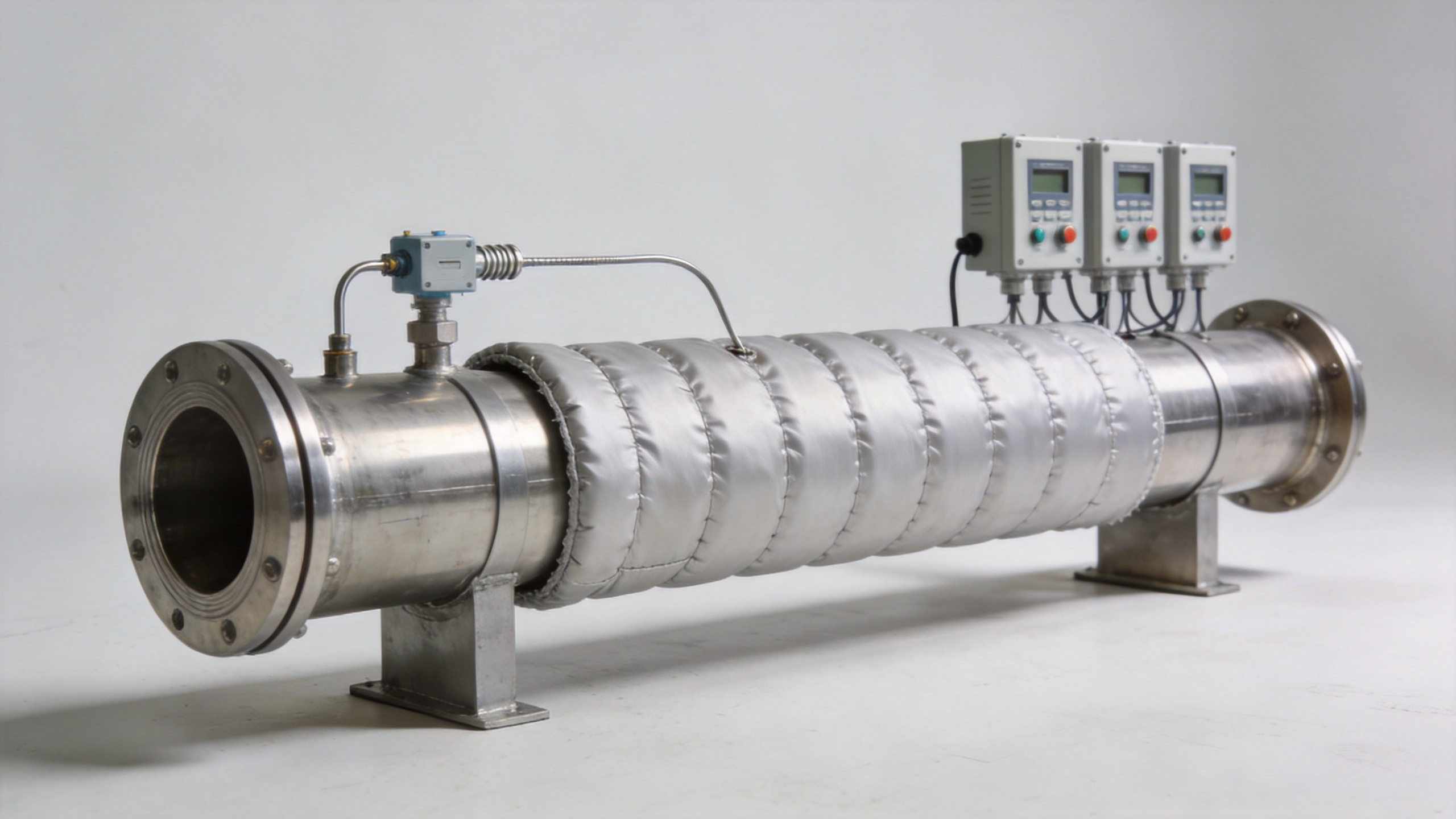
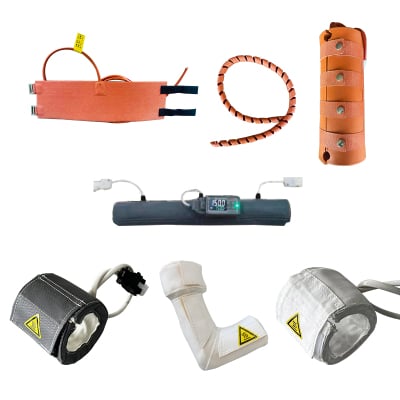
Compared with a point heat source, a pipe heating jacket can place heat over a meaningful length of the line. Good physical contact increases conductive transfer from the heated layer into the pipe wall, while an outer insulating layer limits loss to the surrounding air. When the jacket fits the pipe diameter and covers the right section, the pipe wall is less dependent on heat migrating from a distant source.
Fit is important. Gaps, loose closures, wrinkled coverage, and interrupted insulation can create localized losses that a controller may not immediately reveal. This is especially relevant near bends and fittings, where a flexible pipe heater jacket may be selected to follow the geometry rather than leaving a difficult section exposed.
Zoning matches heat input to real losses
A long line rarely needs identical heat input everywhere. Outdoor sections, sections beside large metal structures, and sections with frequent fittings may need more compensation than a protected indoor run. Dividing the system into zones lets an industrial heating jacket arrangement respond to these different conditions. Zoning also makes troubleshooting clearer: if one area falls behind, the team can inspect the sensor, jacket contact, insulation, and controller response for that zone instead of changing the entire line’s setpoint.
That is why a heating jacket should be specified with the line layout in mind. The goal is to control the temperature distribution, not to assume that one high-wattage section will correct every downstream loss.
Insulation supports efficiency and stability
Heat input without adequate insulation can lead to a constantly working heater and a line that still reacts sharply to ambient changes. The insulation integrated with or installed over a heating jacket slows heat loss, reduces the influence of drafts, and makes the controlled temperature easier to sustain. It also helps prevent a pattern where the jacket surface is hot while an adjacent unheated fitting remains comparatively cold.
Insulation should be treated as part of the thermal system. Its thickness, seams, moisture condition, and continuity around components affect results. A practical inspection therefore includes both the heater assembly and the insulation envelope.
What to evaluate before selecting a heating jacket
An industrial heating jacket is most useful when selection starts with operating conditions rather than a generic size or power rating. Record the following items before finalizing a configuration:
- Process objective: establish whether the line needs freeze protection, viscosity control, condensation prevention, stable analyzer conditions, or another temperature-maintenance purpose.
- Temperature window: define the desired gas temperature, acceptable variation, startup condition, and maximum allowable pipe or product temperature.
- Line geometry: document outside diameter, straight lengths, elbows, valves, flanges, instrument connections, and sections that cannot be covered conventionally.
- Heat-loss conditions: note ambient range, wind or forced airflow, enclosure conditions, insulation, and adjacent cold or hot equipment.
- Control plan: decide where sensors belong, how zones will be controlled, and what alarms or interlocks are required.
- Area classification: where combustible gas may be present, have qualified personnel verify the applicable equipment protection and maximum surface-temperature requirements for the installation.
These inputs prevent a common mistake: treating a heating jacket as an isolated accessory. Its performance depends on the complete heat path from electrical input to jacket contact, pipe wall, process gas, insulation, and ambient surroundings.
Sensor placement and control make uniformity measurable
Uniformity cannot be confirmed by feel or by a single controller display. For a critical line, place sensors where they answer different questions: near the heated section to verify control response, at likely cold spots to reveal loss, and downstream to check the gas condition delivered to the next process stage. The exact arrangement depends on the process, but the principle is consistent: measure the temperature profile, not only the heat source.
A heating jacket paired with a poorly located sensor can cycle on an unrepresentative pipe section while another location drifts. Conversely, sensor feedback from the right thermal location allows the controller to respond to the condition that matters. During commissioning, record temperatures at several points through startup, steady operation, and expected ambient or flow changes. The data provides a better basis for adjusting zones or insulation than increasing setpoint blindly.
Installation details that protect uniformity
Before energizing a pipe heating jacket, inspect the pipe surface, closure system, cable routing, terminations, and insulation restoration. The jacket should sit against the intended surface without damage or unplanned compression. Keep serviceable components accessible where maintenance is expected, and avoid routing that puts cables under mechanical strain. A removable heating jacket can simplify access, but repeated removal should not leave gaps or inconsistent reinstallation.
For gas service, the electrical and process safety review must be specific to the site. Do not infer suitability from a general product category. Verify the area classification, maximum surface-temperature limitations, grounding, protective devices, control failure behavior, and installation instructions with the responsible engineering and safety teams.
A practical verification sequence
- Map the line, fittings, insulation breaks, and expected cold zones.
- Set a process-specific temperature target and allowable variation.
- Install the heating jacket with consistent contact and restore insulation continuity.
- Configure zones and sensors to represent both control points and likely cold spots.
- Trend temperatures during startup and realistic flow or ambient changes.
- Correct contact, insulation, zoning, or sensor placement before raising the overall setpoint.
This sequence makes a heating jacket part of a repeatable temperature-control approach rather than a last-minute correction for a cold pipe section.
Conclusion
A heating jacket improves gas-line temperature uniformity by distributing heat near the locations where losses occur, reducing the effect of localized cold spots, and supporting more meaningful zone control. A dependable result comes from matching the jacket and insulation to the actual line geometry, ambient exposure, gas duty, and safety constraints. If those conditions are not yet defined, start there. A measured thermal profile and a clear control plan will usually yield a more stable line than simply adding more heat.
 Hot News