
Why a Battery Pack Testing Chiller Matters for Pack Safety
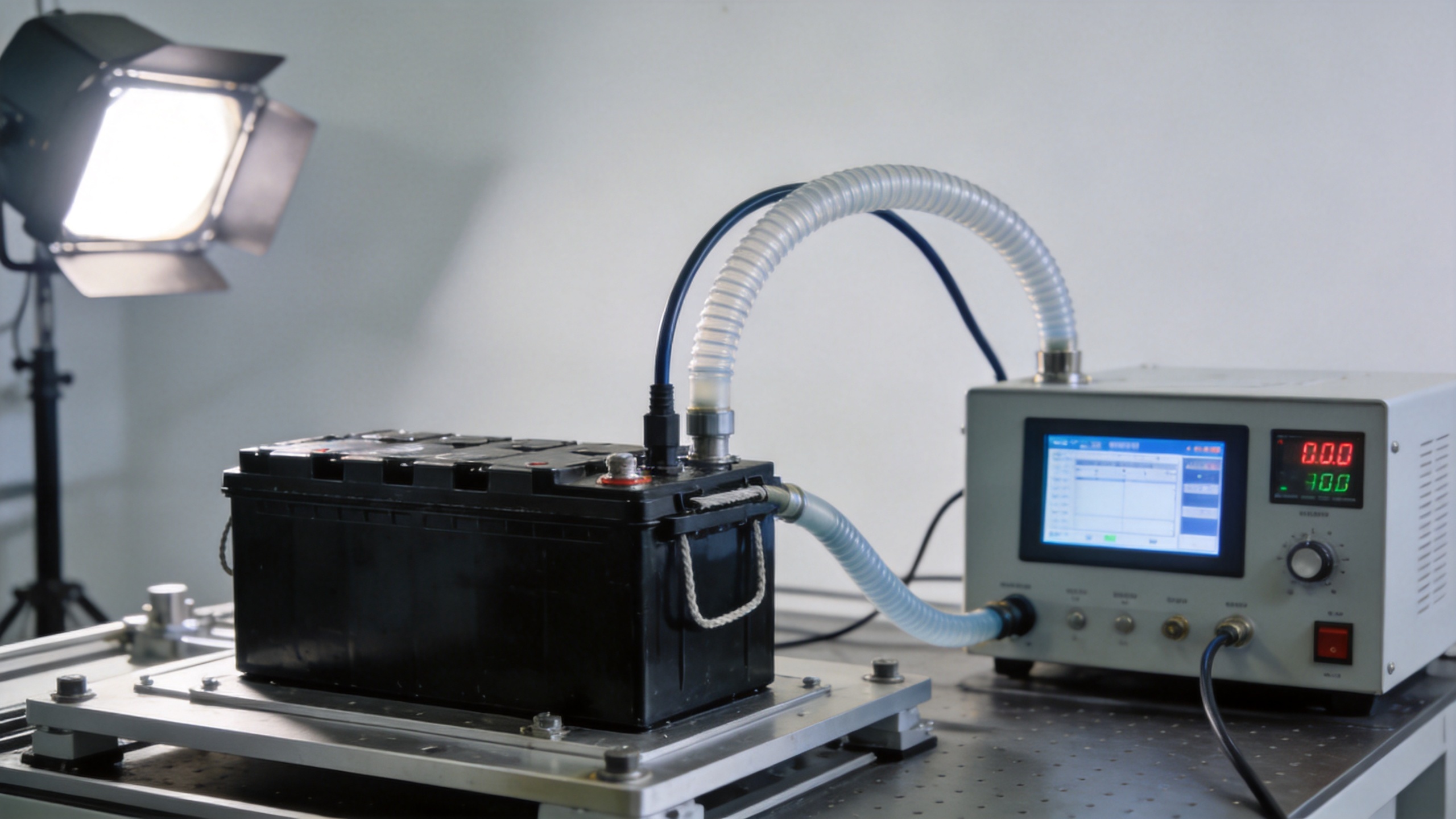
Battery-pack safety testing is not only a question of what happens at the battery terminals. It also depends on whether the thermal environment is known, stable, and recorded. A battery pack testing chiller supplies controlled coolant to a pack, fixture, or thermal plate so the test team can place temperature alongside voltage, current, insulation, and mechanical observations. That makes it easier to separate a pack response from an uncontrolled change in the laboratory environment.
From a heat-management application engineer’s perspective, the useful starting point is the test condition: target temperature, expected heat load, coolant medium, flow path, control connection, and test duration. An industrial chiller selected for battery work should be evaluated against those conditions rather than chosen from cooling capacity alone.
Temperature control is part of a credible safety-test setup
Lithium-ion packs can generate heat during charge, discharge, cycling, and abuse tests. When heat generation exceeds the heat leaving the system, cell temperature can rise rapidly and influence neighboring cells. A battery management system remains responsible for monitoring and acting on pack signals; a battery pack testing chiller is laboratory support equipment, not a substitute for the pack’s protection logic.
Its value is control and repeatability. If inlet coolant temperature drifts, a test may appear to show a change in pack behavior when the underlying difference is actually the boundary condition. With a properly planned battery pack testing chiller, engineers can document the thermal boundary condition, stabilize a test before the main sequence begins, and compare runs under defined settings.
Where an industrial chiller supports pack-safety work
An industrial chiller may be used in environmental conditioning, charge-discharge cycling, thermal exposure, cooling-plate development, and pack-level validation. The exact role changes with the protocol. In a cycling rig, the chiller may remove heat from a plate or liquid circuit. In a temperature-transition procedure, it may help establish and hold a scheduled condition. In a fault-investigation setup, it can help researchers reproduce a defined pre-test thermal state.
That distinction matters. A controlled system does not turn a safety test into a safe activity by itself. Test-cell design, isolation, emergency response, ventilation, detection, containment, and the applicable procedure still require review. The battery pack testing chiller contributes a measurable, controllable thermal input to that broader setup.
Why repeatable coolant conditions improve decisions
They reduce uncertainty around thermal loading
Battery heat generation is dynamic. It can change with state of charge, current profile, ambient conditions, pack construction, and the sequence of the test. If the coolant loop cannot follow the changing load, supply temperature and pack-surface temperature may move in ways that complicate interpretation. More accurately, the needed response is determined by the load profile and permitted temperature deviation, not simply by a nameplate cooling number.
Recording supply and return temperature, flow, pressure where relevant, and the chiller operating state provides a more useful test record. It also helps identify whether an observed temperature rise coincided with a change in electrical loading or a limitation in the external thermal loop.
They make comparison across tests more meaningful
Repeatability is especially important when a team compares pack designs, cooling plates, control strategies, or aging states. A battery pack testing chiller can establish the same programmed coolant condition for each run, subject to the site’s measurement uncertainty and protocol. When the initial condition, control band, and heat-rejection path are documented, a difference between runs is less likely to be attributed to an unrecorded laboratory change.
They expose integration issues earlier
Thermal performance is a system question. Hose routing, quick connectors, coolant compatibility, restriction through the fixture, elevation changes, insulation, sensor placement, and communications can all affect the result. From common engineering practice, checking the loop connection before comparing equipment often reduces later rework. A capable industrial chiller still needs a compatible fixture and a test automation plan that captures the relevant signals.
What to specify for a battery pack testing chiller
Instead of asking only for a setpoint and a cooling capacity, build the specification around the intended test. The following checklist gives a practical starting point:
- Temperature range and stability: Define normal operating points, transitions, dwell periods, and the allowed variation at the measurement location. Verify whether the requirement applies to chiller outlet temperature, fixture inlet, or pack connection.
- Dynamic heat load: Provide expected steady and peak loads, plus the rate at which they change. An industrial chiller sized only for a steady estimate may behave differently during high-current pulses or transitions.
- Coolant and materials: State whether the loop uses water, a water-glycol mixture, dielectric fluid, or another approved medium. Confirm compatible seals, metals, hoses, and service practices.
- Flow and pressure: Define the needed flow window and allowable pressure drop across the pack or fixture. Too little flow can weaken heat transfer; excessive pressure may stress the test article or plumbing.
- Controls and data: Identify remote start/stop, alarm contacts, interlocks, communications, and logging needs. The test controller should know when the thermal loop has reached an agreed ready condition.
- Safety integration: Review leak management, electrical isolation, emergency shutdown behavior, ventilation, and the response to loss of flow or temperature deviation with the test-cell safety plan.
Standards context: use the current protocol, not a generic temperature claim
Pack testing may be performed under customer requirements, internal validation plans, or standards such as UL 2580 for electric-vehicle batteries. Published reviews of automotive battery abuse standards show that thermal-shock requirements vary by standard and edition; one review describes cited upper limits from 60°C to 85°C. That range is context, not a universal setpoint. The current edition of the applicable standard, the test method, pack design, and the laboratory procedure must determine the actual profile.
For this reason, an industrial chiller should be discussed in terms of its ability to support the specified profile and provide traceable operating data. It should not be represented as evidence that a pack meets a standard or that it can independently stop thermal propagation.
A practical commissioning sequence
- Map the thermal loop from chiller outlet to fixture return, including sensors, valves, hoses, and isolation points.
- Run a water-side or approved-fluid checkout without a battery pack to confirm flow direction, pressure drop, alarms, and control response.
- Verify temperature at the point named in the test method, not only at the battery pack testing chiller display.
- Exercise remote commands and interlocks with the test controller before a live sequence.
- Record setpoint, actual supply and return temperatures, flow, ambient conditions, and relevant electrical data in the test record.
- Review deviations after the run and decide whether a repeat is needed under corrected conditions.
Conclusion
A battery pack testing chiller matters because it turns a loosely controlled thermal influence into a planned and documented test condition. The decision should begin with the required temperature profile, heat-load curve, coolant, flow path, controls, and test-cell connections. When those details are defined, an industrial chiller can support clearer comparisons and more defensible pack-safety evaluations. Before procurement or testing, confirm the final operating envelope with the responsible test engineer and the applicable safety procedure.
 Hot News