
Why a Pipe Heating System Reduces Gas Line Contamination Risk
In a gas-handling process, contamination does not necessarily originate at the source. It can develop inside the line when a gas stream crosses a cold section, its temperature falls near a relevant dew point, and liquid forms where the system was expected to remain dry. From a process-risk perspective, that is why a pipe heating system deserves attention: it can help maintain a more stable thermal condition through vulnerable sections of pipe. It is not a substitute for gas drying, filtration, drainage, materials selection, or a site safety review. Used as part of a controlled design, however, it can reduce one important pathway by which moisture and the debris associated with it enter a gas line.
The contamination pathway starts with a temperature change
Gas can carry water vapor even when it appears clean and dry at an upstream point. As pressure, composition, ambient conditions, or line temperature change, the amount of vapor the gas can retain also changes. If the wall temperature drops below the applicable dew-point condition, some vapor may condense into liquid. The result can be a local wet area rather than a uniformly wet pipeline, which is exactly why low points, outdoor runs, uninsulated valves, and intermittent-flow sections deserve careful attention.
Once liquid is present, the risk is broader than water alone. Moisture can support corrosion in susceptible metallic components, carry particles, disturb deposits, and create a surface on which process residues collect. In some services, it may also increase the need to assess hydrate formation, freezing, or compatibility issues. These outcomes are service-specific, not automatic. Still, the sequence is familiar: gas cools, condensate appears, the line environment changes, and contamination-control work becomes harder.
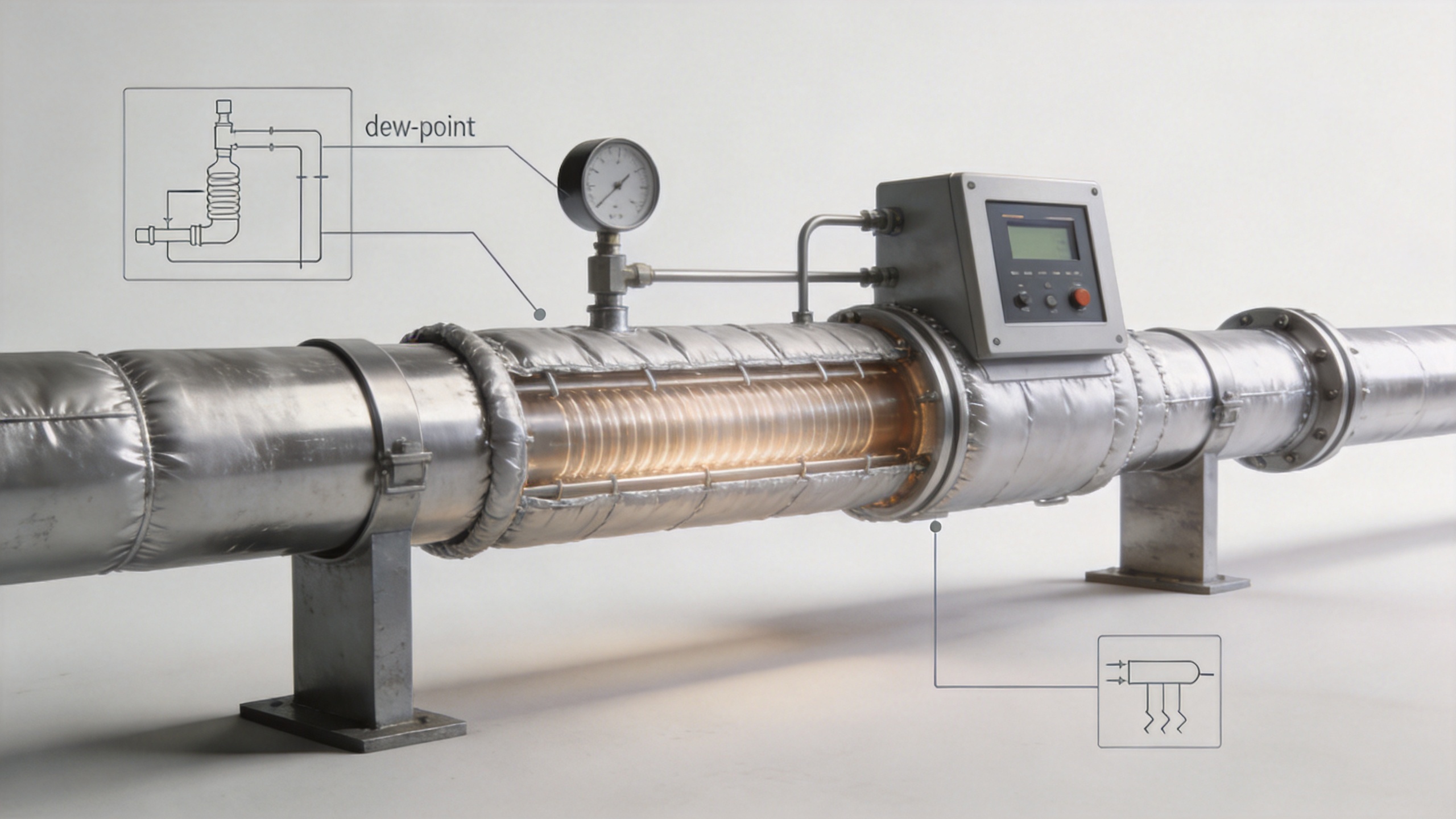
A pipe heating system interrupts that sequence by reducing uncontrolled heat loss. Rather than allowing a critical run to follow every ambient temperature swing, it supplies controlled heat so the pipe wall can remain within a defined operating envelope. The correct envelope must be based on the actual gas, pressure, flow profile, insulation, and allowable surface temperature; there is no universal setpoint that fits every gas line.
How controlled heating helps keep the line dry
The basic goal is straightforward: keep the line condition away from the point at which condensate is likely to form. In practice, the engineering work is more detailed. A pipe heating system may be applied to a short transfer section, a valve cluster, a regulator station, a sample line, or a long exposed run. The design must account for heat loss at fittings and supports, not only the straight pipe. A cold flange or an unheated dead leg can become the first place where a well-intended thermal strategy breaks down.
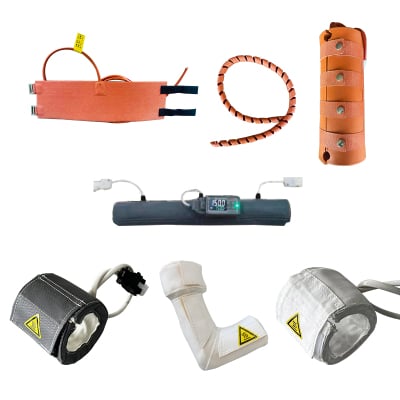
A pipe heating jacket can be useful where a removable, conforming solution is needed around irregular geometry or equipment that needs periodic access. A heating jacket should be selected as part of the thermal system, not treated as a generic wrap. Its fit, insulation coverage, heater zoning, fastening method, ingress protection, sensor placement, and serviceability all affect how evenly the assembly performs. Poor contact or uncovered gaps can create temperature gradients that undermine the purpose of the installation.
For stable operation, control matters as much as heat input. A sensor placed where it only sees a warm section can give a misleading indication of line condition. The control point should represent the portion of the line most likely to lose heat, while high-temperature limits and alarms should reflect the process and the applicable electrical and area-classification requirements. A temperature trend is often more useful than a single reading because it reveals whether the system holds its target through starts, stops, and ambient changes.
Why contamination risk is reduced, not eliminated
It is important to state the boundary clearly. A pipe heating system does not remove water already dissolved in or entrained with the gas, and it does not capture particles that are already moving downstream. Dryers, separators, coalescing filters, drain points, sampling practices, and compatible materials still have distinct roles. Heating reduces the likelihood that thermal loss will turn water vapor into liquid at a critical location. That is a meaningful preventive control, but it belongs in a wider gas-quality plan.
The same caution applies to corrosion. Holding a pipe above a condensation condition may reduce one driver for water-related corrosion, but it cannot correct existing damage, incompatible materials, poor drainage, or contaminated supply gas. If corrosion products have already accumulated, the system may need inspection and cleaning before a thermal-control upgrade can deliver its intended benefit. In other words, the question is not simply whether to add heat; it is whether the heating plan fits the identified contamination mechanism.
Where a heating jacket can add practical value
A heating jacket is often considered when access, geometry, and maintenance frequency matter. For example, removable coverage may suit a valve body, a small manifold, or a segment that cannot be easily placed inside a permanent enclosure. A modular arrangement can also make it easier to inspect the underlying surface during planned maintenance. These are practical advantages, not proof that a jacket is suitable for every duty.
When assessing a heating jacket, ask practical questions: Does the jacket cover the areas that actually lose heat? Can it be removed without damaging sensors or insulation? Are joints, valves, and supports treated as part of the heat-loss calculation? Is the power supply and controller appropriate for the location? And does the maintenance procedure verify both electrical condition and thermal performance? A pipe heater jacket may be effective only when these details are tied back to the process conditions.
A commissioning checklist for contamination-focused heating
- Define the gas condition. Document gas composition, pressure range, expected water content or dew-point information, flow pattern, and process limits.
- Map vulnerable sections. Include outdoor runs, low points, dead legs, fittings, instrumentation, supports, and areas exposed to washdown or changing ambient conditions.
- Set the thermal objective. Establish a justified temperature margin or operating range rather than choosing an arbitrary heater setting.
- Coordinate with other controls. Confirm how the pipe heating system works alongside dryers, filters, separators, drains, insulation, and monitoring points.
- Check the installation under realistic conditions. Verify sensor readings, controller response, insulation continuity, and accessible maintenance routes during representative operation.
- Review safety and compliance. Electrical classification, surface-temperature limits, over-temperature protection, grounding, permits, and local requirements must be reviewed by qualified personnel.
Make the decision from operating conditions, not product labels
It is tempting to compare heaters by wattage or to select a pipe heating jacket based only on pipe diameter. Those details matter, but they do not answer the contamination question on their own. The relevant comparison starts with the temperature margin needed at the coldest credible point, then considers heat loss, insulation, controls, installation constraints, and the consequences of a temperature excursion. If the duty is variable, staged control or separate zones may be more appropriate than one fixed output.
For a project team, a useful next step is to collect a short operating record: line size and material, route, ambient range, insulation condition, gas pressure and composition, upset conditions, existing moisture-control equipment, and any observed deposits or corrosion. That information supports a defensible thermal review. It also keeps a pipe heating system in the right role: a preventive measure against condensation-related contamination risk, not an unsupported promise of gas purity.
Conclusion
A pipe heating system can reduce gas line contamination risk by making condensation less likely in sections where uncontrolled cooling would otherwise create liquid water. That can help limit one route to corrosion products, deposits, and downstream quality problems. The strongest result comes from integrating heating with verified dew-point information, insulation, drying or separation equipment, drainage, monitoring, and site-specific safety controls. Before selecting a heating jacket or pipe heater jacket, validate the full operating envelope with qualified engineering and the requirements that govern the installation.
 Hot News